
 Written by
 This is the true story of Dashrath Manjhi. In the village of Gehlaur, near Gaya in Bihar, India, a rocky ridge stood between the villagers and everything they needed. The nearest town, the market and the doctor were all on the other side. To reach them, people had to climb over the ridge or walk the long way around.
At the time, he was a landless labourer. He had no money, no machines and no education to speak of. What he had was a wife, Falguni Devi, whom he loved.
Around 1959, crossing the ridge, Falguni was badly injured. Help was far away, and the mountain stood in the way. Accounts differ on the exact details, but they agree on what it meant to Dashrath: the distance had taken his wife, and the distance was a piece of rock.
How Dashrath Manjhi started: a hammer, a chisel and a promise
In 1960, according to the most widely repeated accounts, Dashrath sold some of his goats to buy a hammer and a chisel. Then he walked up to the ridge and started to cut.
At first, people laughed. In fact, they called him mad. Still, he kept going, day after day, before and after his paid work, through drought, famine and the monsoon.
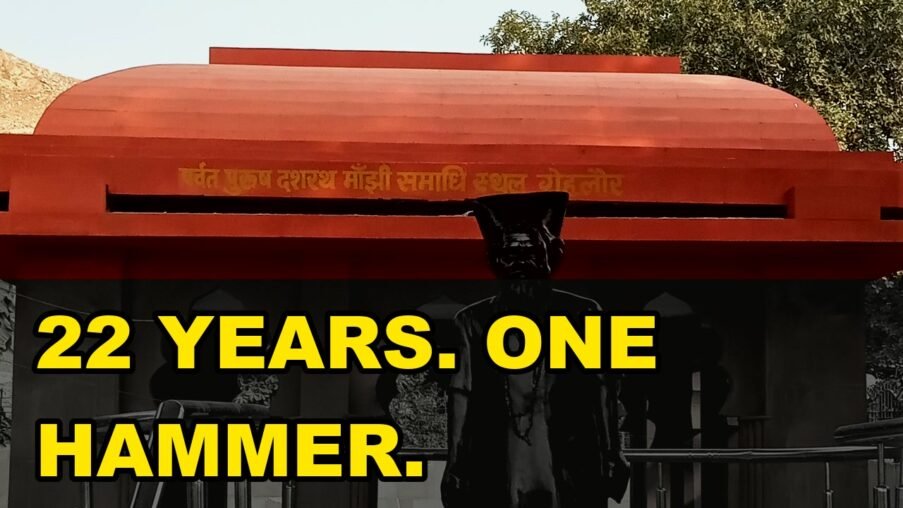
Dashrath Manjhi’s twenty-two years
He kept at it for 22 years. By 1982 he had carved a passage through the rock about 110 metres long, 9 metres wide and in places up to 7.7 metres deep, according to the Bihar government’s own tourism department. As a result, a journey that had meant a long detour around the hills became a short walk. Children could reach school. The sick could reach a doctor.
What one person can move
Dashrath Manjhi died in 2007. The state of Bihar gave him a state funeral, India Post later issued a stamp in his honour, and today people still walk along the road that carries his name. India remembers him as the Mountain Man.
He never became rich, and he never had a machine. However, he had a reason, and so he kept going.
Every life has a story
Most of us will never cut through a mountain. But almost every family has someone who quietly did something extraordinary: a grandmother who kept a family together, a father who worked two jobs, a neighbour who never gave up. Those stories disappear when nobody writes them down. That is why we built Tale of Life: a free place to write your life story, or the story of someone you love, one chapter at a time.
Prefer to listen? The full episode is on Spotify: Tales of Life: Ordinary People, Extraordinary True Stories.
Sources: Bihar Tourism, Wikipedia, Atlas Obscura. Photos in the video: Wikimedia Commons (CC BY-SA 4.0, GODL-India).