
 Written by
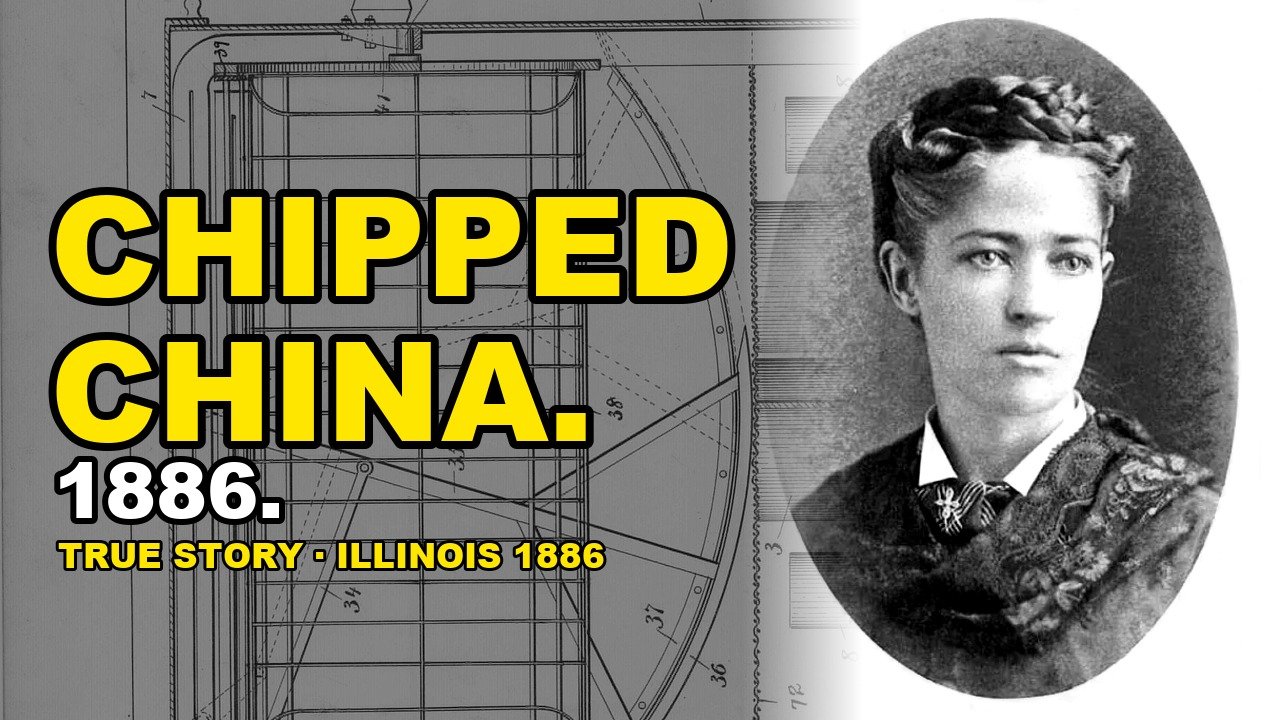
Shelbyville, Illinois, in the 1880s. A dinner party has just ended. The guests have gone home, and the plates come back from the kitchen. Josephine Cochrane picks one up and runs her finger along the edge. Another chip. Her family’s fine china is being ruined, one wash at a time. And she is said to have declared: if nobody else is going to invent a dishwashing machine, I’ll do it myself.
A family of inventors
She was born Josephine Garis in Ohio in 1839. Invention ran in her family. Her father was a civil engineer, and her great-grandfather, John Fitch, built the first steamboat to receive a United States patent. In 1858 she married William Cochran, a merchant, and took his name, adding an e at the end. In 1870 they moved into a large house in Shelbyville, where they often hosted dinners.
After every dinner, the dishes were washed by hand, and her fine heirloom china came back chipped. She tried washing it herself, and some of it chipped in her hands too. There had to be a better way.
Widowed and in debt
Then, in 1883, her husband died. He left her about 1,535 dollars and a lot of debt. Suddenly the dishwasher was not just a clever idea. It could become a way to make a living.
Josephine had never studied engineering. But she understood the problem better than anyone. And she had that sentence in her head: if nobody else is going to do it, I’ll do it myself.
Racks, a wheel and hot water
She began by measuring. Every plate, every cup, every saucer. Then she designed wire compartments shaped to hold each piece firmly in its own place. The compartments fitted into a wheel that lay flat inside a copper boiler. A motor turned the wheel, and hot soapy water sprayed up over the dishes.
That was her clever idea. Earlier machines tried to scrub the dishes, and often broke them. Josephine’s machine did not scrub at all. It held each piece still and let the force of the hot water do the work.
She built the first model in a shed behind her house in Shelbyville, with a mechanic named George Butters. On the twenty-eighth of December 1886, she received her patent.
The 1893 World’s Fair
At first she built machines for friends and neighbours. They were too big and too expensive for most homes. But hotels and restaurants, with mountains of dishes every single day, were very interested.
Her big moment came in 1893, at the World’s Columbian Exposition in Chicago, the great World’s Fair. Nine of her machines were installed at the fair, washing dishes for the crowds. And she won an award for the best mechanical construction, durability and adaptation to its line of work.
After the fair, the orders came. When investors suggested that she should step aside so the business could be sold to a man, she refused, and kept running her company herself. In 1898 she opened her own factory, with George Butters as the manager.
Into every kitchen
She never stopped improving her machine. She died in Chicago in 1913, at the age of seventy-four, and one of her later designs was patented only after her death.
Her company lived on. In 1926 it became part of KitchenAid. For a long time dishwashers were found mainly in hotels and restaurants, but in the 1950s they began to move into ordinary family kitchens.
In 2006, Josephine Cochrane was inducted into the National Inventors Hall of Fame.
Tonight, in millions of homes, someone will clear the table, open a door and slide the plates into neat racks, each plate in its own place, just as Josephine measured them. Then the family will sit down together instead of standing at the sink.
What we can learn
Josephine Cochrane had no engineering degree, no husband to support her and no money to spare. She had a problem she understood better than any engineer, and the courage to start. Many families have a woman like her: a grandmother who ran a household on very little and still found clever ways to make life easier. Her story deserves to be written down too.
A shelf of fine family china, a chipped plate, and a woman who decided to do it herself. Every rack of clean plates still carries her idea.
Who in your family ran the household with clever tricks? Get free questions to ask them, read our step-by-step guide on how to write your life story, and start writing your own story at talesof.life.
Sources: IEEE Spectrum – Who invented the dishwasher?; Wikipedia – Josephine Cochrane; Popular Science – The forgotten story of the woman who invented the dishwasher. Pictures: Josephine Cochrane (public domain) and her 1886 patent drawing (US National Archives, public domain), via Wikimedia Commons.