
 Written by
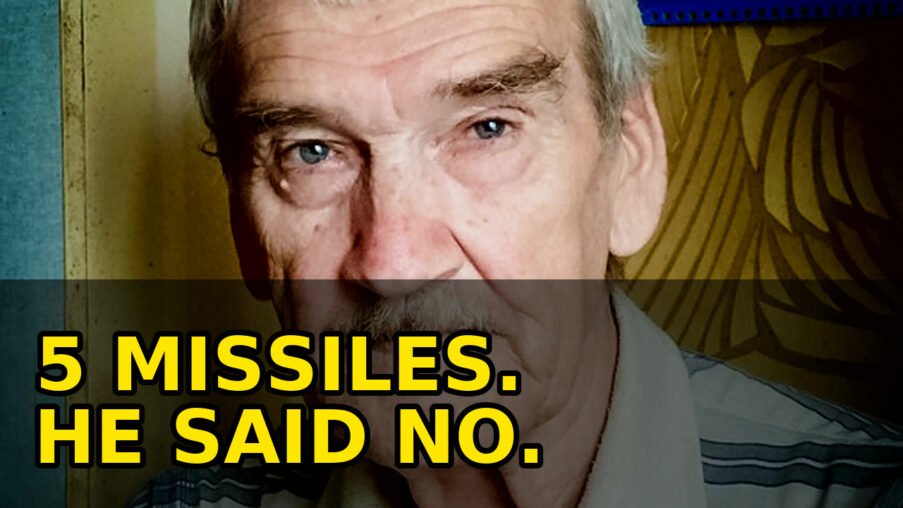
 This is the true story of Stanislav Petrov. Shortly after midnight on 26 September 1983, a siren went off in a secret bunker south of Moscow. On a large screen, one word lit up in red: launch. The Soviet early-warning system was reporting that the United States had fired a nuclear missile. Then four more.
The duty officer that night was Lieutenant Colonel Stanislav Petrov, a 44-year-old engineer who had helped put the system into service. His orders were to report what the system showed, so that the Soviet leadership could decide whether to strike back.
Why the choice of Stanislav Petrov mattered
To understand the danger, remember that three weeks earlier, on 1 September 1983, a Soviet fighter had shot down Korean Air Lines Flight 007, killing 269 people. Trust between the superpowers was close to zero, and the Soviet leadership feared an American first strike. In that atmosphere, a missile warning would not be treated as a technical question.
Fifty-fifty: how Stanislav Petrov decided
Petrov later said he sat for a few seconds, staring at the red screen, feeling like he was sitting on a hot frying pan. He thought the chances were fifty-fifty that the warning was real. However, things did not add up. A real American attack, he reasoned, would come with hundreds of missiles, not five. The satellite system was new and he did not fully trust it. And the ground radars showed nothing.
So he reported it as a false alarm, and then he waited. Twenty-three minutes later, nothing had happened. In his own words, it was such a relief.
What the screen of Stanislav Petrov really showed
In the end, investigators found the cause: sunlight reflecting off high-altitude clouds, which the satellites had mistaken for the flames of rocket engines.
No medal, no reward
At first, Petrov was praised. Then he was reprimanded for incomplete paperwork. There was no reward, because his decision showed that the expensive new system could make a catastrophic mistake. He left the army in 1984, and the story stayed secret until 1998, when his former commander, General Yuri Votintsev, wrote about it in his memoirs.
Eventually came a World Citizen Award, an honour at the United Nations and the Dresden Peace Prize in 2013. Petrov never called himself a hero. He said he was just doing his job, and added: they were lucky it was me on shift that night. He died in May 2017, and the world only learned of it months later.
The quiet kind of courage
In short, Petrov did not win a battle or build anything the world could see. He stopped something from happening, and that kind of courage almost never makes the history books. Every family has people like that: the ones who stayed calm, asked one more question and quietly kept the worst from happening. Their stories are worth writing down.
Prefer to listen? The full episode is on Spotify: Tales of Life: Ordinary People, Extraordinary True Stories.
Sources: Wikipedia, 1983 Soviet nuclear false alarm incident, Wikipedia, Stanislav Petrov, TIME (2017), BBC interview (2013).