
 Written by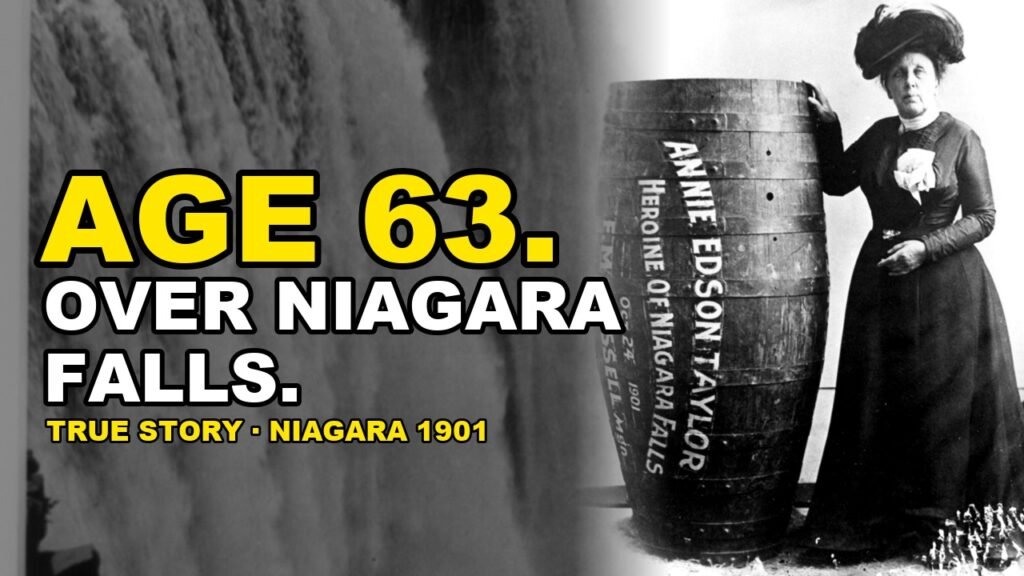
This is the true story of Annie Edson Taylor. On 24 October 1901, her 63rd birthday, the widowed schoolteacher climbed into an oak barrel above Niagara Falls. No one had ever gone over the falls in a barrel and survived. She did, and then she spent twenty years finding out what it had cost her.
Annie Edson Taylor, a widow on her own
Annie Edson was born on 24 October 1838 in Auburn, New York, one of eight children. Her father owned a flour mill and died when she was twelve. She trained as a schoolteacher and married a man named David Taylor. First their baby son died, and not long after, her husband died too. From then on, Annie earned her own living.
She taught school, opened a dancing school in Bay City, Michigan, and taught music. She moved from city to city, as far as San Antonio and Mexico City, and nothing lasted. By 1900 her home had burned, her savings were gone, and she was in her sixties. In the census that year she gave her birth year as 1860. For a woman who needed work, being old was a risk she could not afford.
An idea no one had survived
In 1901 the Pan-American Exposition in Buffalo brought millions of visitors to the region, and Niagara Falls was the great attraction nearby. Annie Edson Taylor decided she would become the first person to go over the falls in a barrel. The fame, she hoped, would pay for her old age.
Daredevils had ridden the rapids below the falls before. Nobody had gone over the Horseshoe Falls itself and lived. The drop is about 167 feet, into a wall of white water and mist.
The barrel and the cat
She ordered a barrel of oak and iron bands, about five feet tall, padded inside with a mattress and, according to reports, weighted with an anvil so it would float upright. A few days before her attempt, her helpers sent a cat over the falls in it. Rumours said the cat had died. In fact, it had not. It came out with a cut on its head and later posed for photographs with Annie.
Over the Horseshoe Falls on her 63rd birthday
On 24 October 1901 a crowd of a few thousand people gathered along the river. Annie climbed into the barrel with a small heart-shaped pillow she considered lucky. Her helpers screwed down the lid, pumped air in with a bicycle pump and plugged the hole with a cork. Then they set the barrel adrift near the American shore above Goat Island, and the current carried it through the rapids to the edge.
Finally, just after four in the afternoon, it went over and disappeared into the mist. It came up. The current carried it to a rock, the rescuers reached it, and when they opened the lid, Annie Edson Taylor was alive. She was dazed and bleeding from a small cut on her head. The whole trip had taken less than twenty minutes.
Even so, afterwards she told reporters she would sooner walk up to the mouth of a cannon than go over the falls again.
Queen of the Mist, and the stolen barrel
For a moment her plan worked. At the Pan-American Exposition organisers presented her as the Queen of the Mist, gave talks and sold a short account of her life. Then her manager, Frank Russell, disappeared with the barrel, the one thing people would pay to see. Annie spent most of her savings on detectives. They found it in Chicago, but then another manager stole it again.
As a result, for the next twenty years she lived in Niagara Falls and posed for photographs with tourists at a souvenir stand by the river. She worked as a clairvoyant, talked about a second plunge, started a novel and tried to recreate her ride on film. She died in the county infirmary in Lockport, New York, on 29 April 1921, aged 82, without any money. Instead, the public paid for her funeral. She is buried in Oakwood Cemetery in Niagara Falls, in the section known as Stunters’ Rest.
What Annie Edson Taylor’s story asks of us
It is easy to tell this as a joke about an old lady in a barrel. However, look at it the way she lived it: a woman who had lost her child, her husband, her home and her savings, who was told she was too old, and who refused to disappear. Every family has someone like that, a grandmother who started over at sixty or an aunt who never stopped trying. Their stories are worth writing down, one chapter at a time.
Prefer to listen? The full episode is on Spotify and Apple Podcasts.
Sources: Wikipedia, Annie Edson Taylor, NY State Parks, Remembering the Queen of the Mist, Atlas Obscura, Annie Edson Taylor’s 1901 retirement plan. Photos: Wikimedia Commons, Library of Congress / Detroit Publishing Co. (public domain).