
 Written by
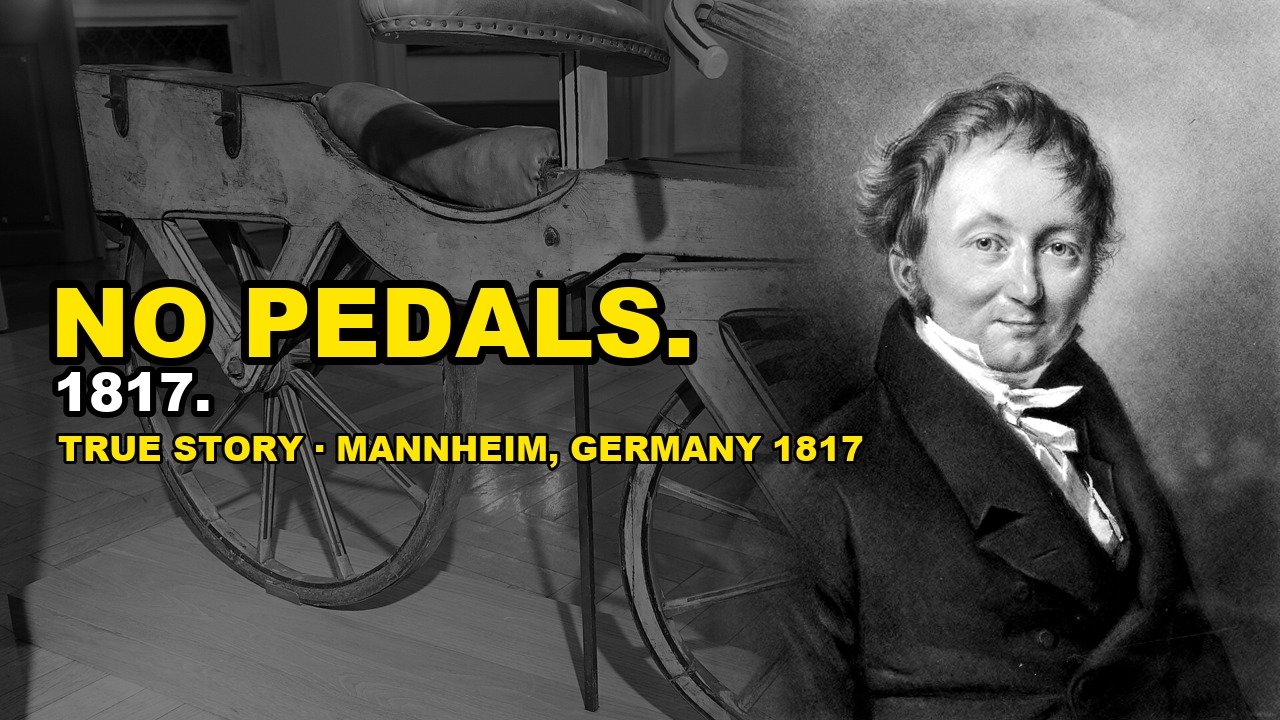
Mannheim, Germany, the twelfth of June, 1817. A man sits on a strange wooden machine. Two wheels, one behind the other. A small padded seat. A bar in front to steer. No pedals at all. He pushes the road with his feet, long strides, left, right, left, and then something surprising happens. He lifts his feet, and he keeps rolling. His name is Karl Drais, and he is riding the first bicycle in the world.
A year without a summer
Then came a year nobody in Europe would forget. In April 1815, a volcano called Tambora exploded on an island in what is now Indonesia. Its ash spread around the world and cooled the sky. The next year, 1816, became known as the year without a summer. It snowed in July in some places. Crops failed. Food became terribly expensive.
It was hard even for horses. When there is not enough grain for people, there is not enough for animals either, and many horses died or were eaten. Some historians believe this crisis made Drais’s old question more urgent: how can a person travel without a horse? We cannot know for sure what was in his mind. But we know what he built next.
Two wooden wheels in a line
His answer was a wooden running machine. In German it was called the Laufmaschine. Two wooden wheels stood in a straight line, joined by a wooden frame. The rider sat on a cushion, rested his arms on a small board and steered the front wheel with a bar. You pushed the ground with your feet, like running while sitting down. And when you went fast enough, you could lift your feet and balance.
That was the real discovery. Most people at the time believed you could not balance on two wheels in a line. Drais showed that you could, as long as you kept moving and kept steering.
On that June day in 1817 he rode out of Mannheim along the best road in Baden to a coaching inn and back, about fourteen kilometres in all, in around an hour. Weeks later a local newspaper reported the ride. In January 1818, the Grand Duke of Baden granted him a privilege for ten years, an early kind of patent.
Paris, London and the copycats
In April 1818, his machine was shown in the Luxembourg Gardens in Paris, and thousands of people paid to watch. A London newspaper wrote that it went quicker than a man at full speed.
In London, a coachmaker named Denis Johnson built a lighter version, and in 1819 the dandy horse became a craze. Riding schools opened. Young gentlemen raced each other. Cartoonists filled the print shops with funny pictures of riders tumbling into the mud.
But fame is fast, and it can be gone just as quickly. Riders took to the pavements, pedestrians complained, and several cities banned the machines. Drais’s privilege protected him only in Baden. Everywhere else, anyone could build a copy, and many did. The man who had started it all earned almost nothing.
Penniless, but never forgotten
The years that followed were hard. Drais left for Brazil in 1822 and worked there as a land surveyor for five years. Back home he kept inventing: a typewriter with a keyboard, a machine for writing shorthand, a meat grinder, and a rail cart moved by the rider’s feet. Railway workers still call such carts draisines, after him.
In the revolution of 1848 and 1849, Drais stood with the people who wanted democracy. He even gave up his noble title. When the revolution failed, his pension was taken away. On the tenth of December 1851, Karl Drais died in Karlsruhe, penniless.
His idea did not die with him. In the 1860s, makers in France added pedals to the front wheel. Later came the chain, rubber tyres and the bicycles we ride today. Every one of them still stands on the discovery he made on that road in 1817: two wheels in a line, balanced by a moving rider.
In 2017, two hundred years after his first ride, Germany celebrated with a special stamp, and cyclists rode his old route out of Mannheim. The man who died poor had finally been remembered.
What we can learn
Walk through any park today and you will see his machine again. A small child on a little bike with no pedals, pushing the ground with both feet, then lifting them, wobbling, and gliding. A balance bike works exactly like the Laufmaschine. Children all over the world learn to ride the way Karl Drais rode in 1817.
Karl Drais was not a famous engineer with a big factory. He was a curious man in a hard year who asked a simple question. Many families have someone like him: a grandfather in the shed, a mother with a clever trick, an uncle who could fix anything. Their ideas rarely reach a museum. Usually they live only in our memories, unless someone writes them down.
Who taught you to ride a bike? Get free questions to ask them, read our step-by-step guide on how to write your life story, and start writing your own story at talesof.life.
Sources: Wikipedia – Karl Drais; Cycling UK – Draisienne 1817-2017: 200 years of cycling innovation and design; German Patent and Trade Mark Office – 200 years of the patent for the first bicycle. Photo: Karl Drais on his running machine (public domain) and his Laufmaschine of 1817 (Mattes, public domain), via Wikimedia Commons.