
 Written by
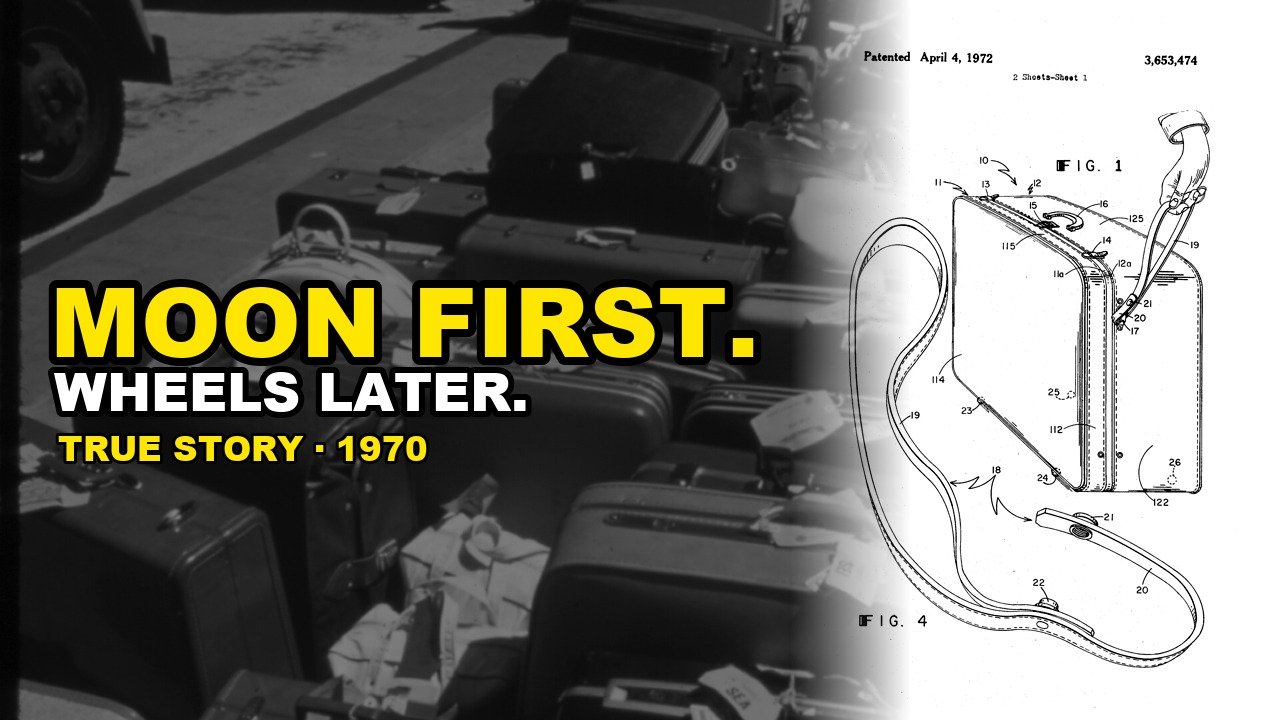
In July 1969, two men walked on the Moon. Millions of people watched it on television. And a year later, in an airport on the way home from a family holiday in Aruba, a man named Bernard Sadow was doing what every traveller in the world still did. He was carrying two heavy suitcases, one in each hand, and his arms were aching.
Before suitcases rolled
It is hard to imagine today, but in 1970 suitcases did not roll. You carried them. Porters carried them for you, if you could pay. At the airport you dragged them from the plane to the customs hall and on to the taxi, one heavy step at a time.
Bernard Sadow knew suitcases better than most people. He was a vice president of a luggage company in Massachusetts. He sold suitcases for a living. And still, standing in that customs line with two heavy bags, he had never thought about wheels.
That’s what we need for luggage
Then he looked up. An airport worker was moving a heavy machine across the floor. He was not carrying it. It sat on a little platform with wheels, and the worker pushed it along with almost no effort.
Bernard turned to his wife and said something like: you know, that’s what we need for luggage. It was a small sentence. It would change the way the whole world travels.
Back at his company’s factory, he tried it at once. He took four casters, the little wheels from the bottom of a wardrobe trunk, and fixed them to a big suitcase. He added a strap at the front. Then he pulled it across the floor. It rolled. It worked.
The stores said no
Now came the hard part. For months he took his rolling suitcase to the big department stores in New York. And one after another, they said no. Buyers believed men would never want to pull a suitcase on wheels. Carrying your own bags was what a strong man did. Sadow later remembered that it was, in his words, a very macho thing.
Some people even thought a husband would always carry the bags for his wife, so why would anyone need wheels? A perfectly good idea was being stopped by an old habit.
Then Sadow went to Macy’s. The luggage buyer there turned him away too. But a vice president of the store, Jerry Levy, saw the suitcase and called him back. He told the buyer to order them. In October 1970, Macy’s put Sadow’s suitcase on sale as the luggage that glides.
Travellers who tried it did not want to go back. Little by little, the habit began to change.
From four wheels to two
Sadow applied for a patent, and in 1972 he received United States patent number 3,653,474 for rolling luggage. In the patent he wrote that handling baggage had become perhaps the biggest single difficulty for an air passenger. A few years later, other companies were selling wheeled suitcases of their own.
His first design was not perfect. The suitcase lay flat on four wheels, and you pulled it behind you on a strap like a dog on a lead. On a crowded floor it could wobble and tip over. But the big idea was there: let the wheels carry the weight.
In 1987, a Northwest Airlines pilot named Robert Plath took the next step. In his garage in Florida, he stood the suitcase upright on two wheels and gave it a long handle. He built them first for other pilots and flight attendants. When passengers saw the crews gliding through airports, they wanted one too.
Today almost every suitcase rolls. Little children pull small suitcases shaped like animals. Grandparents glide to their gates without a porter. That soft rolling sound you hear in every airport and every station began with a tired man watching an airport worker push a platform.
What we can learn
Bernard Sadow’s idea was so obvious that it seems strange nobody had it sooner. Many good ideas are like that. They need someone who notices a small everyday struggle and refuses to accept it. Families are full of people like that: a parent with a clever trick for every trip, a grandfather who improved everything he touched. Their ideas deserve to be remembered too, and the easiest way is to write their stories down.
A man on the Moon, a tired traveller at an airport, and two heavy suitcases. Sometimes the best ideas are hiding in plain sight, rolling right past us on a little platform.
Who in your family always carries everyone’s bags? Get free questions to ask them, read our step-by-step guide on how to write your life story, and start writing your own story at talesof.life.
Sources: Smithsonian Lemelson Center – Invention Stories: Roll-aboard; Wikipedia – Suitcase (history of wheeled luggage); Gulf Times – What was life like before luggage had wheels?. Pictures: patent drawing of Bernard Sadow’s rolling luggage (public domain) and Buzz Aldrin on the Moon (NASA, public domain), via Wikimedia Commons.