
 Written by
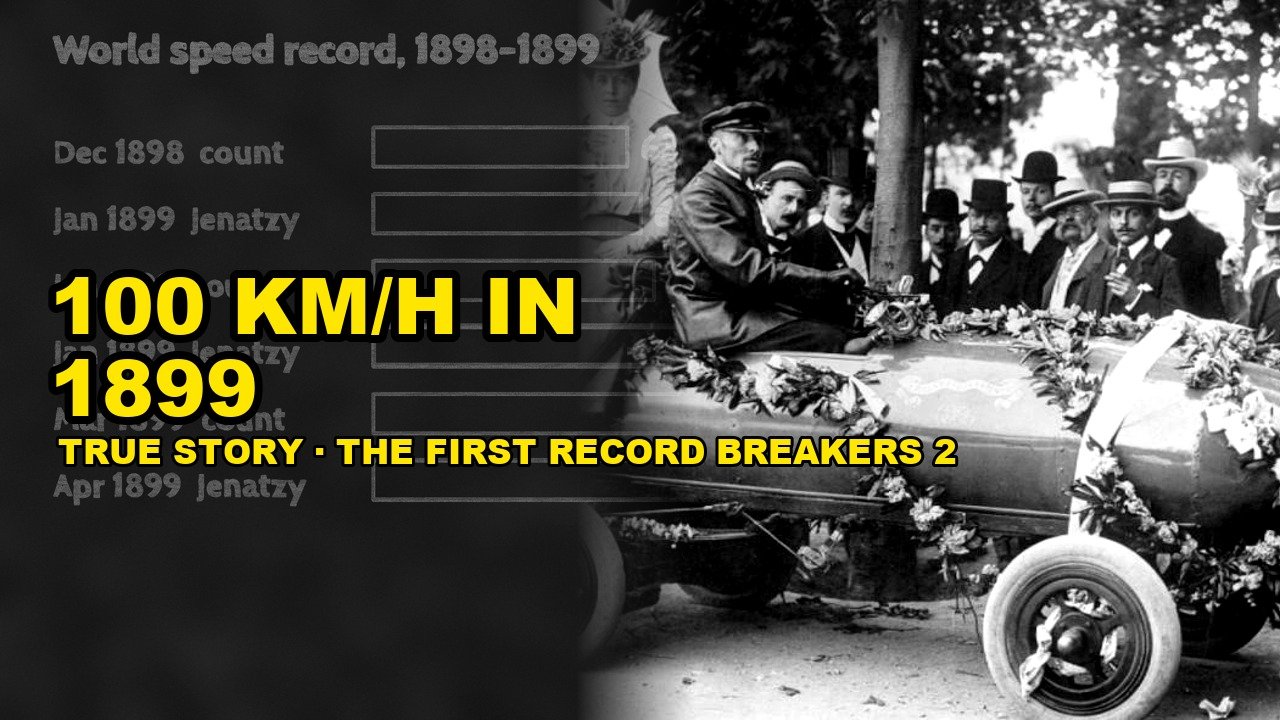
In the spring of 1899, on a straight country road at Achères, just outside Paris, a strange machine was waiting. It looked like a torpedo on four wheels: a long, shining metal bullet, with a man sitting high on top of it. The man had a bright red beard. No car in the world had ever gone faster than a hundred kilometres an hour. He was about to try.
The Red Devil
The man on top was Camille Jenatzy, born in 1868 in Schaerbeek, near Brussels. His family made rubber products, and he had studied as an engineer. Because of his red beard, people called him Le Diable Rouge, the Red Devil. In the late 1890s he was building electric cars in Paris, including electric taxis. At that time electric cars were quiet, clean and easy to start, and many people thought they were the future.
The count and the first speed record
His rival was a French nobleman, Count Gaston de Chasseloup-Laubat. On the eighteenth of December, 1898, at Achères, the count drove an electric car built by the carriage-maker Jeantaud over a measured kilometre at about sixty-three kilometres an hour. It is usually counted as the first land speed record in history.
Jenatzy wanted it. On the seventeenth of January, 1899, he came to Achères and drove at 66.66 kilometres an hour. The count answered on the very same day, and took the record back at seventy. Ten days later Jenatzy reached eighty. On the fourth of March the count, in a new streamlined Jeantaud, went 92.78.
So in just over four months the world speed record had been set six times, and it was edging towards a number that sounded almost impossible: a hundred kilometres an hour. That was faster than any galloping horse.
The Never Satisfied
Jenatzy went back to his workshop. His new car had a body made of partinium, a light alloy of aluminium, tungsten and magnesium, shaped like a bullet to cut through the air. Inside were heavy batteries and two electric motors, one for each rear wheel, giving about sixty-eight horsepower together. The tyres came from a young company called Michelin. And he gave the car a name that said everything about him: La Jamais Contente. The Never Satisfied.
There was one problem he could not solve. To steer, he had to sit high up on top of the bullet, with his head and body out in the wind. The beautiful shape helped, but the driver himself slowed it down.
105.88 km/h
On the twenty-ninth of April, 1899, at Achères, Jenatzy set off down the road. The motors hummed. The bullet picked up speed. Over the measured kilometre, the timekeepers clocked him at 105.88 kilometres an hour, about sixty-six miles an hour. For the first time in history, a car had gone faster than a hundred.
Paris loved it. La Jamais Contente was shown off in parades, decorated with flowers, with Jenatzy on top. The count never took the record back. His record stood for three years, until 1902.
Why petrol won
But history then took a turn. Batteries were heavy and needed hours to charge, and petrol cars could go further and fill up in minutes. Over the next years petrol engines took over racing and then the roads. Jenatzy himself switched to petrol, and in 1903 he won one of the most famous races of the age, the Gordon Bennett Cup in Ireland, driving a Mercedes.
Jenatzy died in 1913 in a hunting accident, only in his mid-forties. But his car survived. You can still see La Jamais Contente today, at the National Car and Tourism Museum at the Château de Compiègne in France. And more than a hundred years later, electric cars are back on our roads.
Rivals who made each other better
There is something warm in this story, too. Jenatzy and the count were rivals, but they pushed each other higher. Without the count, Jenatzy might never have built his bullet. Without Jenatzy, the count might have stopped at sixty-three.
Maybe your family has a story like that. The first car in the family, or the first time someone drove abroad. A friendly rivalry between two brothers or two neighbours that made both of them better. Ask about it, and write it down.
What was the first car in your family, and who drove it? Get free questions to help you write it, read our step-by-step guide on how to write your life story, and start writing your own story at talesof.life.
Sources: Wikipedia – La Jamais Contente; Wikipedia – Camille Jenatzy; Wikipedia – Gaston de Chasseloup-Laubat; Wikipedia – Land speed record. Pictures: Camille Jenatzy in La Jamais Contente, 1899 (Jules Beau, public domain) via Wikimedia Commons.