
 Written by
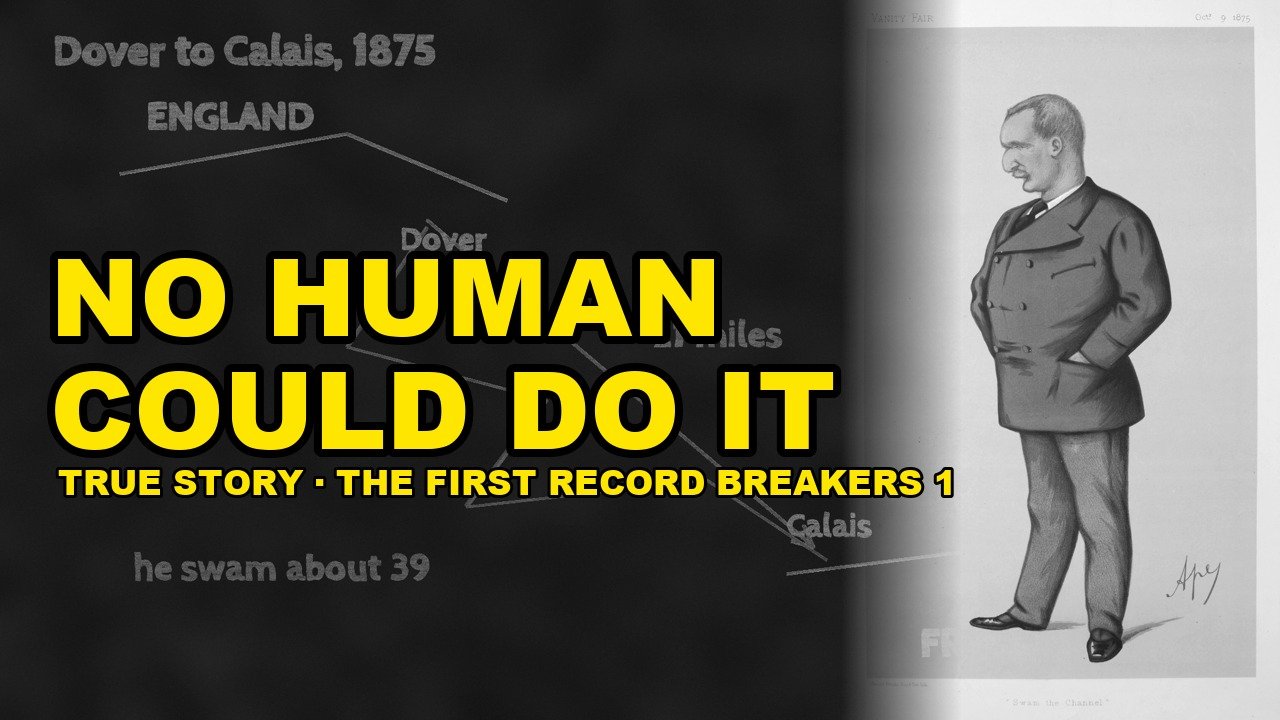
At about one o’clock in the afternoon on the twenty-fourth of August, 1875, a young sailor in a red silk swimming costume stood at the end of Admiralty Pier in Dover. His body was covered in porpoise oil to keep out the cold. Three or four hundred people were watching. Across the water, about twenty-one miles away, lay France. Nobody in history had ever swum there. Most people believed nobody ever could. He dived in.
A doctor’s son who went to sea
Matthew Webb was born on the nineteenth of January, 1848, in Dawley, Shropshire, in the middle of England. His father was a doctor, and Matthew was one of thirteen children. He learned to swim as a boy in the River Severn. At twelve he went to train as a sailor on an old ship called HMS Conway, and he spent the next fifteen years at sea, rising to second mate and later to captain.
A man overboard
In April 1873 he was working on the Cunard ship Russia, crossing the Atlantic, when a man fell overboard. Webb dived straight into the open ocean to save him. He searched the cold waves, but the man was never found. Webb could not save him, but people never forgot his courage. He was given the Stanhope Gold Medal for bravery, and the passengers collected a hundred pounds for him.
The rubber suit and the first try
Two years later Webb read about a man who had crossed the English Channel in a very strange way. In the spring of 1875 an American showman, Paul Boyton, floated from France to England in an inflatable rubber suit, lying on his back and paddling. Webb had a different idea. He wanted to cross with nothing at all: no suit, no boat to hold on to, just his own body.
In June 1875 he gave up his job as captain of a ship called the Emerald to train full time. He swam for hours in the Thames and in the sea off Dover. On the twelfth of August he made his first attempt. The wind rose and the sea turned rough. After seven hours, more than nine miles off course, he had to give up. He went home, rested, and waited for better weather. Twelve days later he tried again.
Into the sea
This time he left the pier at four minutes to one in the afternoon. Three boats went with him, and his brother and his cousin were on board. Webb swam a slow, steady stroke, keeping his head low and blowing like a porpoise. He had eaten bacon and eggs before he started, and through the day and night his crew handed him beef tea, coffee, ale, brandy and cod liver oil.
At about half past eight in the evening a jellyfish stung him. It hurt badly, and the pain stayed with him for hours. His crew gave him a little brandy and he kept swimming. Then night came. The boats carried lanterns, and someone sang to keep his spirits up.
The long night
The Channel is not a calm lake. Twice a day its tides pour one way and then the other, and they pushed Webb up and down the coast in a long zigzag. The straight distance was about twenty-one miles. In the end he swam about thirty-nine. Near the French coast the tide turned against him, and for hours he could see the land but hardly get any closer.
France
At about twenty to eleven on the morning of the twenty-fifth of August, he touched the sand near Calais and walked out of the sea. He had been swimming for twenty-one hours and forty-five minutes. He was utterly exhausted, but he had done it. Matthew Webb was the first person ever recorded to swim the English Channel.
Back in England he was a hero. Crowds cheered him in Dover and newspapers everywhere told his story. He said he hoped it would encourage more people to learn to swim. And here is how hard it was: nobody managed to do it again for thirty-six years, until Thomas Burgess swam across in 1911.
Nothing great is easy
Webb spent the rest of his short life as a professional swimmer, giving shows and taking on long swimming challenges. He married Madeline Chaddock in 1880, and they had two children. In 1883 he tried to swim the wild rapids below Niagara Falls, and he did not survive. He was thirty-five.
Today there are memorials to him in Dover and in Dawley, where he was born. The one in Dawley carries four words that sum up his life: Nothing great is easy.
His story is not only about strength. Webb failed on his first try, went home, and came back twelve days later. Almost every family has someone like that: the one who tried a second time. Ask the older people in your family about their firsts. The first in the family to go to university, to cross an ocean, to start a business. Those stories are worth writing down.
Who in your family did something first? Get free questions to help you write it, read our step-by-step guide on how to write your life story, and start writing your own story at talesof.life.
Sources: Wikipedia – Matthew Webb; Dover Historian – Captain Matthew Webb, the first person to swim the Channel; Wikipedia – Paul Boyton. Pictures: Matthew Webb in Vanity Fair, 1875 (Carlo Pellegrini, public domain) via Wikimedia Commons.