
 Written by
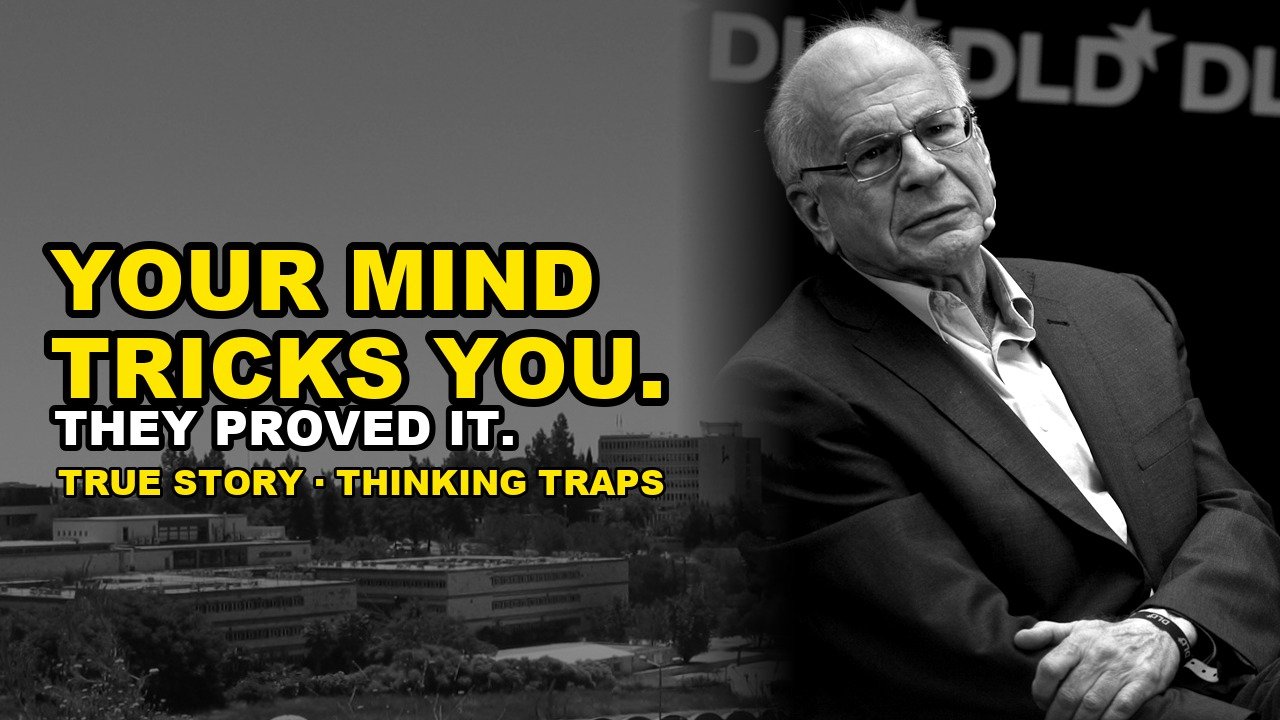
In the spring of 1969, a young professor walked into a seminar at the Hebrew University of Jerusalem and gave a talk. When he finished, the man who had invited him told him, politely but firmly, that he was wrong. That argument was the beginning of one of the most famous friendships in the history of science. The two men were Amos Tversky and Daniel Kahneman. Together they showed the world something uncomfortable: our minds play the same tricks on us, again and again, in ways that can be predicted.
The boy in Paris
Daniel Kahneman, Danny to his friends, was born in 1934 in Tel Aviv, and grew up in Paris. When the Germans occupied France, his family was Jewish, and their lives were in danger. In his Nobel autobiography he remembered one evening, around 1941 or 1942, when he stayed too long at a friend’s house and walked home after the curfew, his sweater turned inside out to hide the yellow star.
A German soldier in the black uniform of the SS called him over. Danny was terrified. But the soldier picked him up and hugged him, showed him a photograph of a little boy, and gave him some money. Danny went home thinking that his mother had been right: people are endlessly complicated and surprising. His father died in 1944, just weeks before the Allied landings he had waited for. After the war, Danny, his mother and his sister moved to Palestine, which soon became Israel. He studied psychology, and at twenty-one, as a young lieutenant, he designed an interview system for the Israeli army that stayed in use for decades.
The paratrooper
Amos Tversky was born in Haifa in 1937. He served as a paratrooper, made more than fifty jumps, and in 1956 he was decorated for bravery after saving a soldier during a training exercise. He was fast, funny and famously sure of himself. Colleagues joked that the quicker you realised Amos was smarter than you, the smarter you were.
In 1969 Danny invited Amos to speak in his seminar. Amos described experiments with bags of poker chips, which suggested that people are fairly good intuitive statisticians: when new evidence arrives, we adjust our beliefs more or less sensibly. Danny thought that was simply not true. He saw it in his students and in himself: intuition makes mistakes, all the time. They argued. And then, instead of walking away, they started meeting every day.
One small room
For years they worked together in one small room, often for hours, talking and laughing so loudly that people in the corridor could hear them. Their method was simple. They invented little puzzles and tried them on themselves first. If both of them felt the pull of the wrong answer, other people probably would too. They tossed a coin to decide whose name came first on their first paper, and after that they took turns. Their ideas were owned jointly. Years later Danny wrote that he had probably shared more than half of the laughs of his life with Amos.
Shortcuts in the mind
In 1974 they published a paper in the journal Science called Judgment under Uncertainty: Heuristics and Biases. A heuristic is a mental shortcut. Most of the time shortcuts help us. But they also lead us into the same errors, again and again.
One shortcut is availability: we judge how common something is by how easily examples come to mind. After a plane crash is in the news, flying feels more dangerous, even though nothing about flying has changed. Another is anchoring. In one experiment, people watched a wheel of fortune that was secretly set to stop at either 10 or 65. Then they were asked what percentage of African countries were members of the United Nations. Those who saw 10 guessed about 25 percent on average. Those who saw 65 guessed about 45. A meaningless number had pulled their answers.
Losses hurt more
In 1979 they published Prospect Theory, which became one of the most cited papers in economics. Its central idea is easy to feel. Losing 100 euros hurts more than winning 100 euros feels good. We are not neutral about gains and losses. We fear losses about twice as much, and that changes how we take risks, buy insurance, sell houses and invest.
This was a shock for economics. For a long time, economic models had assumed a perfectly rational person who always calculates the best choice. Two psychologists were showing that real people make predictable mistakes. A young economist named Richard Thaler read their work and went to spend a year near them at Stanford. Out of that meeting grew a whole new field: behavioural economics.
Apart
Fame came, but it came unevenly. In the late 1970s Amos moved to Stanford University, and Danny to Canada and later to Berkeley and Princeton. The world gave much of the credit to Amos, and Danny found that painful. In the 1980s their collaboration slowed, and their friendship went through hard years.
In 1996 Amos was diagnosed with melanoma, a skin cancer that had already spread. He died on the second of June, 1996, at the age of fifty-nine.
The Nobel Prize
In 2002, Daniel Kahneman received the Nobel Prize in Economic Sciences, for bringing the insights of psychology into economics. Nobel Prizes are not given after death, so Amos could not share it. But Danny made sure everyone knew whose prize it really was. It was, he said, a joint prize. They had been twinned for more than a decade. In 2011 he wrote Thinking, Fast and Slow, and dedicated it to the memory of Amos Tversky. Danny died in 2024, at the age of ninety.
What they gave us
What did they give us? Not the idea that people are foolish. The idea that good, clever people make the same mistakes in the same ways. And once you can see a trap, you can step around it. In this series we’ll look at seven of them: framing, confirmation bias, overconfidence, the outside view, the premortem, sunk costs, and nudges.
And there is one more lesson in their story. Their best ideas came from a friendship: two people who trusted each other enough to admit their own errors, out loud, and laugh about them. The stories we tell about our own lives are full of these traps too. Writing them down, honestly, is one of the best ways to see them clearly.
Two friends, one small room, and a lot of laughter. That is where the science of our thinking traps began.
Who is the friend who made you think more clearly? Their story belongs in yours. Get free questions to help you write it, read our step-by-step guide on how to write your life story, and start writing your own story at talesof.life.
Sources: Daniel Kahneman – Nobel Prize biographical (2002); Wikipedia – Daniel Kahneman; Wikipedia – Amos Tversky; Tversky & Kahneman (1974), Judgment under Uncertainty: Heuristics and Biases, Science 185; Kahneman & Tversky (1979), Prospect Theory, Econometrica 47; Michael Lewis, The Undoing Project (2016). Photos: Daniel Kahneman in 2009 (nrkbeta, CC BY-SA 2.0) and the Givat Ram campus of the Hebrew University (public domain), via Wikimedia Commons.