
 Written by
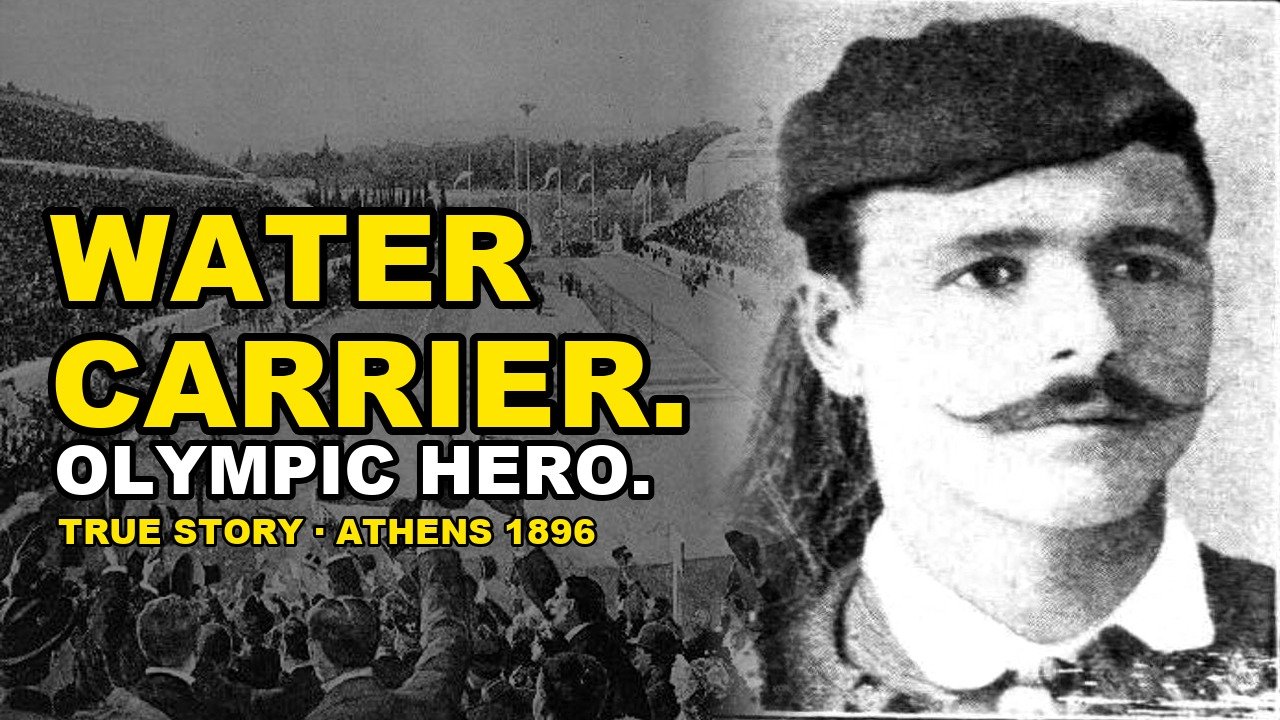
On the tenth of April 1896, the Panathenaic Stadium in Athens was full. Tens of thousands of people were waiting for the end of a race that had never been run before. Then news arrived from the road: the leader was a Greek. The crowd went wild. And a few minutes later, a slim man with a moustache ran in through the gate. He carried water for a living.
A water carrier from Marousi
Spyridon was born in 1873 in Marousi, then a village just north of Athens. His family made their living by bringing fresh mineral water into the city. Spyridon helped his father carry that water to the people of Athens. He had also served in the army.
He was not a famous athlete. He had no club and no coach. But he was strong, and he was used to covering long distances on foot, every single day.
A brand-new race
The marathon was something completely new. There had been no such race in the ancient Olympics. It was the idea of a French scholar, Michel Bréal, who was inspired by an old legend: that after the battle of Marathon, a messenger ran all the way to Athens to announce the victory. Bréal offered a silver cup to the winner.
For the Greeks, the race was a matter of national pride. They had organised the Games, but foreign athletes had won most of the events. The marathon, run on Greek roads in honour of a Greek legend, was the race they wanted most.
The favourites fall
The runners started at the bridge in Marathon and headed for Athens, about forty kilometres away. At first a Frenchman, Albin Lermusiaux, raced ahead. But he had gone too fast, and after about twenty-six kilometres he had to stop.
Then the Australian Edwin Flack took the lead. Flack had already won the 800 and 1,500 metres at these Games. But the marathon was too much for him too, and a few kilometres later he collapsed. Louis, running at his own steady pace, moved into first place.
A drink at Pikermi
Along the way, Louis stopped in the village of Pikermi. The famous story says he drank a glass of wine there, and said he would win. His grandson later told a different version: that his girlfriend gave him half an orange, and his future father-in-law a glass of cognac. Either way, he set off again, refreshed, and nobody caught him.
As the news reached the stadium, the excitement became almost unbearable. People stood up and shouted his name.
Into the stadium
When Louis came through the gate, two sons of the King, Crown Prince Constantine and Prince George, jumped down and ran the last lap beside him. He crossed the line in 2 hours, 58 minutes and 50 seconds. A water carrier from Marousi was the first Olympic marathon champion.
Greece was overjoyed. Louis was offered gifts from every side: jewellery, money, even a free shave for the rest of his life. In the Greek language a new expression was born: to become Louis, meaning to run off very fast.
A horse and cart
But when he was asked what he wanted from the King, Spyridon Louis did not ask for riches. He asked for a horse and cart, to make his work of carrying water easier. He took it home, and went back to his village.
He lived a quiet life afterwards, as a farmer and later as a police officer. In 1936 he was a guest of honour at the Olympic Games in Berlin and carried the Greek flag at the opening ceremony. He died in 1940, at the age of sixty-seven. His silver cup, the Bréal Cup, was sold at auction in 2012 to a Greek foundation, and today it is on display in Athens.
The end of The First Olympians
With Spyridon Louis, our series comes to an end. Over seven episodes we met a cook, a student, a swimmer, a visitor, a gymnast, a young mother and a water carrier. None of them was rich or famous before. All of them are remembered because someone wrote their story down.
And that is what I hope you take with you. Every family has people like them: a grandfather who worked hard all his life and never asked for much, a grandmother who did something brave that nobody wrote about. Their stories are worth keeping too. And they can be written one chapter at a time.
Who in your family worked hard all their life and never asked for much? Get free questions to ask them, read our step-by-step guide on how to write your life story, and start writing your own story at talesof.life.
Sources: Wikipedia – Spyridon Louis; Olympics.com – Local hero Spyridon Louis earns cult status in marathon; World Athletics – 1896 Olympic marathon: Spiridon Louis 125th anniversary and the Bréal Cup; Wikipedia – Athletics at the 1896 Summer Olympics, men’s marathon. Pictures: Spyridon Louis and his entry into the Panathenaic Stadium in 1896 (public domain), via Wikimedia Commons.