
 Written by
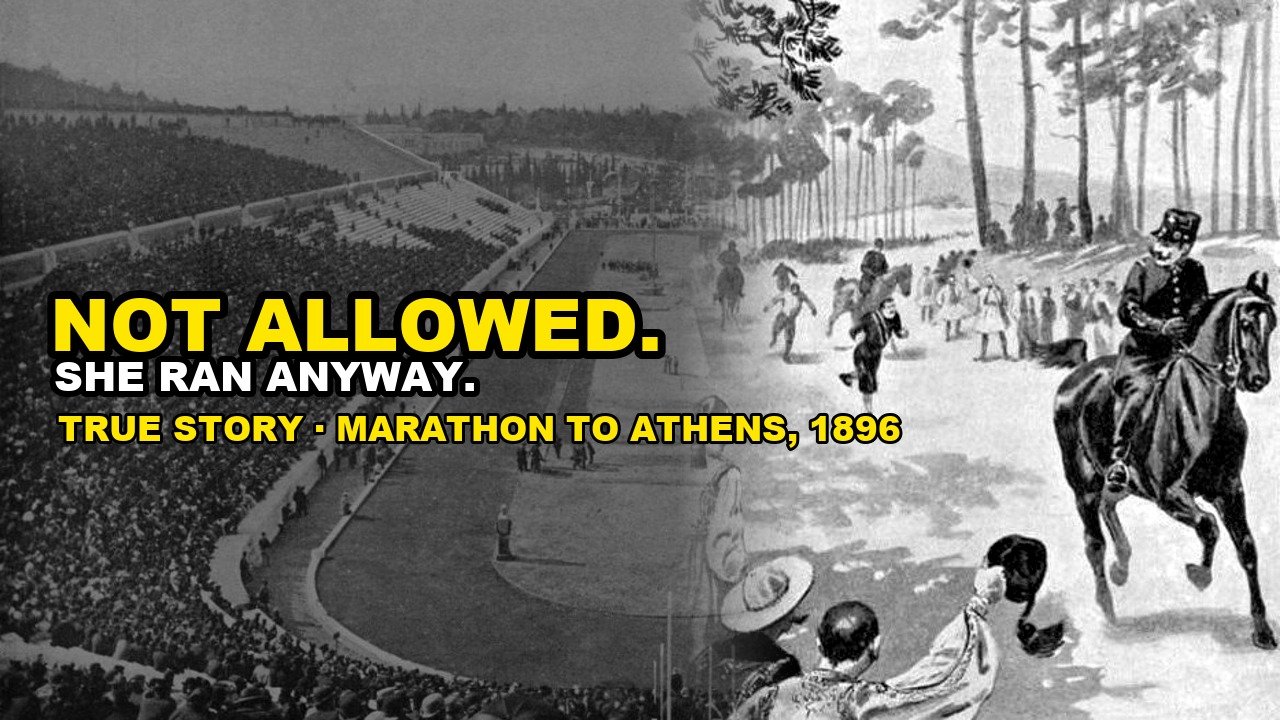
Early on the morning of the eleventh of April 1896, in the village of Marathon in Greece, a young woman went to three men: the village teacher, the mayor and the magistrate. She asked them to sign a piece of paper with the time. It was eight o’clock. Then she started running towards Athens, forty kilometres away, completely alone. The day before, she had not been allowed to run.
A mother from Piraeus
Stamata was born on the island of Syros in 1866. By 1896 she was about thirty years old and living in poverty in Piraeus, the port of Athens. She had a baby of seventeen months. The year before, she had lost her seven-year-old son. Historians describe her as thin, with large eyes, looking older than her age.
As a child she had loved running long distances. But there was no sport for a poor woman in Greece in 1896. Her life was about finding work and feeding her child.
The road to Marathon
A few days before the marathon, she set off on foot from Piraeus towards Athens, hoping to find work in the city. On the road she met a runner, a man, who told her about the great race. Running the marathon, he said, could make her famous, and might help her find a job.
Stamata believed she could do it. She even believed she could beat the men. So instead of looking for work, she made her way to the village of Marathon, where the race would start. She arrived on Thursday, the ninth of April, and the mayor gave her a place to stay.
Not allowed
On Friday, the day of the race, the runners gathered. Stamata asked to start with them. The organising committee said no. Officially, the reason was that the deadline for entries had passed. Many historians believe the real reason was simple: she was a woman. Even the local priest refused to give her his blessing.
She watched the men leave. Later that day, a water carrier from a village near Athens won the race, and the whole country celebrated. You will meet him in the next episode.
Running alone
But Stamata had not given up. The next morning she found the teacher, the mayor and the magistrate, and asked them to sign a statement with her starting time. With that piece of paper, at eight o’clock, she began to run.
She ran alone, along the same dusty road, past the same hills and olive trees. There were no crowds, no officials and no water stations. When she was tired she slowed down, and then she kept going. After about five and a half hours, around half past one in the afternoon, she reached the edge of Athens.
Stopped at the gate
But she never entered the Olympic stadium. Soldiers stopped her at a place called Parapigmata, near where a hospital stands today. Stamata did not argue. She asked the officers to sign her paper with her arrival time, and they did.
She wanted to take her signed papers to the Olympic committee, to show what she had done. We do not know if she ever met them. Her papers have never been found. And after that day, Stamata Revithi disappears from the records. Nobody knows what happened to her or to her child.
Melpomene
There is one more mystery. Some newspapers in 1896 wrote about a woman called Melpomene, who was said to have run the marathon distance in about four and a half hours. Some historians think there were two different women. Others think Melpomene and Stamata were the same person, and that officials simply did not remember her real name.
What we do know is this. Women were first allowed to compete in some Olympic events in 1900. But the women’s marathon only became an Olympic race in 1984, in Los Angeles. Eighty-eight years after a young mother from Piraeus ran the road from Marathon alone.
What we can learn
We know so little about Stamata Revithi: no photograph, no date of death, no word about what happened to her child. A few signatures on a lost piece of paper are almost all that remains. Her story reminds me how many women’s lives in our own families went unrecorded. Mothers and grandmothers who did brave things that nobody wrote down. A few pages, written while we still can, can save so much.
An early morning in Marathon, three signatures on a piece of paper, and a young woman running alone towards Athens. She was stopped at the gate. But she had already proved what she came to prove.
Which brave woman in your family was never written about? Get free questions to ask them, read our step-by-step guide on how to write your life story, and start writing your own story at talesof.life.
Sources: Wikipedia – Stamata Revithi; Marathons.com – Stamata Revithi, the anonymous glory; Wikipedia – Athletics at the 1896 Summer Olympics, men’s marathon; Wikipedia – Women’s marathon at the 1984 Summer Olympics. Picture: a drawing of the 1896 Olympic marathon by Raymond de la Nézière (public domain), via Wikimedia Commons. No photograph of Stamata Revithi is known.