
 Written by
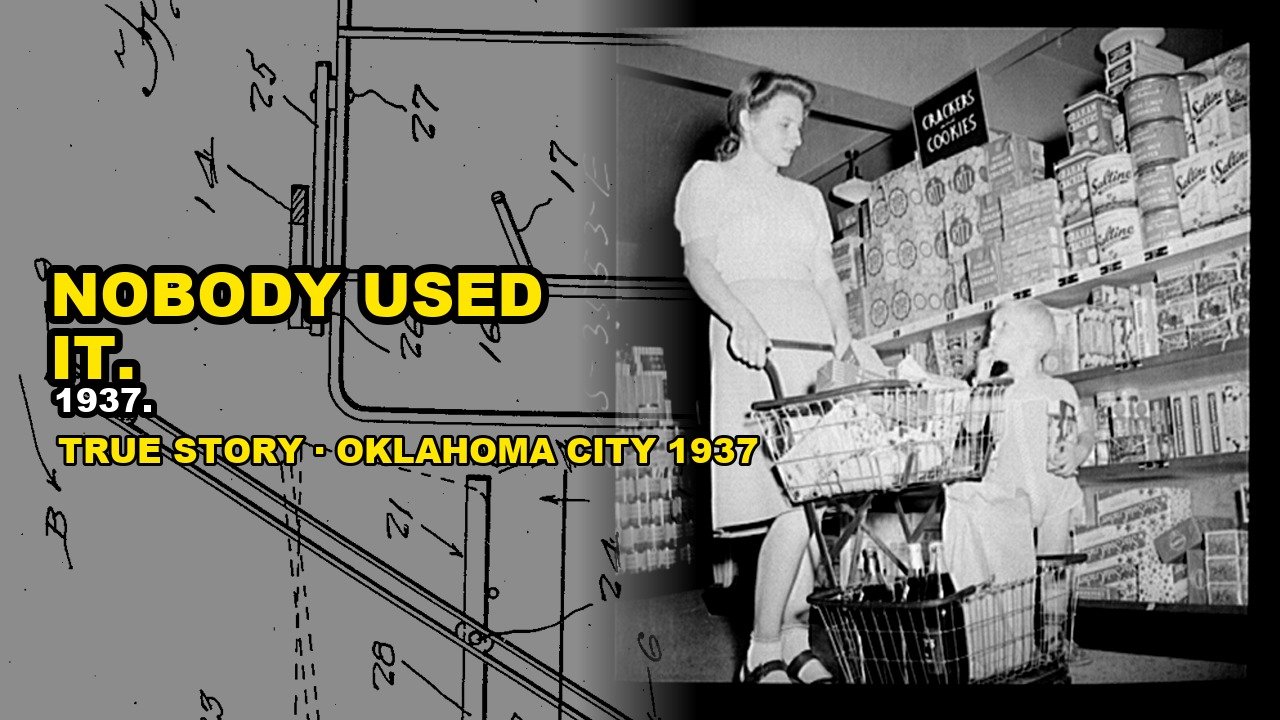
Oklahoma City, June 1937. In a Humpty Dumpty supermarket, something new stands near the door: a row of folding metal frames on wheels, each holding two wire baskets. The owner, Sylvan Goldman, has advertised them in the newspaper. It’s new. It’s sensational. And the shoppers walk right past them.
A grocer from Oklahoma
Sylvan Goldman was born in 1898 in Ardmore, in what was then called Indian Territory, before it became the state of Oklahoma. He grew up in the grocery business. With his brother he built a chain of grocery stores, sold it in 1929, and then lost much of his money in the great crash. In 1934 they started again in Oklahoma City and bought the Humpty Dumpty supermarkets.
In those days, shoppers carried wire baskets on their arms. When a basket was full, it was heavy. Goldman wanted to make shopping easier, and he hoped that customers who did not have to carry everything would also buy a little more.
Two folding chairs
One evening in 1936, he was sitting in his office and looked at two folding chairs. He imagined putting a basket on the seat of a chair and wheels on its legs. A chair that you could push, and that folded flat when you did not need it.
With a mechanic named Fred Young, he built it. It was a folding metal frame on four wheels, holding two wire baskets, one above the other. When shoppers were done, the frames folded away and took up very little room.
On the fourth of June 1937, the carts went into his stores, with that proud advertisement in the newspaper.
Too proud to push
And almost nobody used them. Young men did not want to push a cart. They did not want to look as if they were too weak to carry a basket. Women were not impressed either. They said the carts looked like baby carriages. One shopper told the staff that she had pushed her last baby buggy.
Goldman had a brilliant invention, and his customers were too proud to use it. Many inventors would have given up there.
Paid to push it
Instead, Goldman tried something clever. He hired people, men and women, to push his carts around the store, filling them with groceries as if they were ordinary shoppers. He placed a greeter at the door to offer each customer a cart and explain how it worked.
Slowly, it worked. Shoppers saw other people pushing carts and decided to try one. They found they could buy as much as they wanted without aching arms. Older shoppers were especially grateful.
Everyone wants one
Soon stores all over America wanted carts like his. Goldman started a company to make them, the Folding Carrier Corporation, and received a patent for his folding basket carriage in 1940. He earned money on carts all over the country and became a multimillionaire.
Later, other inventors improved his design, with carts that fitted inside each other in a long line, the kind we use today. But the idea, a basket on wheels you push through the store, was his. Many years later he said that if he had not invented it, someone else would have. Perhaps. But he was the one who did it, and who would not give up when nobody wanted it.
Sylvan Goldman died in 1984. One of his early carts is now in the Oklahoma History Center, a museum in Oklahoma City.
Next time you are in a supermarket, look around. A grandmother leaning on her cart as she reads a label. A father pushing a toddler who is steering with both hands. It all began with a grocer staring at two folding chairs, and with his patience when everybody said no.
What we can learn
Sylvan Goldman’s idea was simple. The hard part was changing people’s minds. Many families have someone like that: a shopkeeper, a farmer, a mother who tried something new and kept going while the neighbours shook their heads. Their stories of small, stubborn courage are worth keeping, and the best way to keep them is to write them down.
Two folding chairs, a wire basket, and a store full of people too proud to push. Every cart that rolls through a supermarket today began with one grocer who would not give up on his idea.
Who did the shopping in your family when you were a child? Get free questions to ask them, read our step-by-step guide on how to write your life story, and start writing your own story at talesof.life.
Sources: Oklahoma Historical Society – Oklahoma History Center audio tour (Sylvan Goldman’s shopping cart); Gulf Times – Simple yet brilliant: the shopping cart 80 years on; Wikipedia – Sylvan Goldman. Pictures: shopping in a cooperative grocery store, 1942 (Marjory Collins, Library of Congress, public domain) and Goldman’s patent drawing (public domain), via Wikimedia Commons.