
 Written by
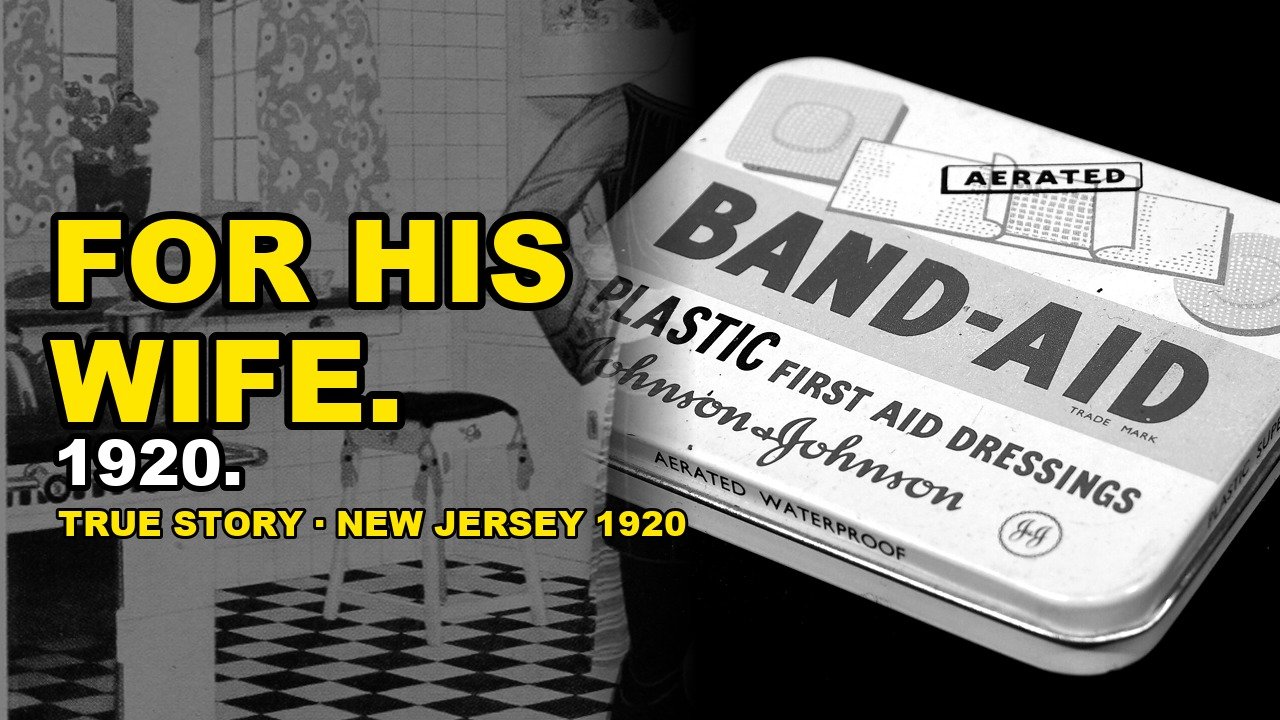
New Jersey, around 1920. A young wife is cooking in her small kitchen. The knife slips, and she cuts her finger. Again. The bandages of the time are big pieces of gauze and tape, and they will not stay on a busy finger. And she cannot wrap them properly by herself. When her husband comes home, he has an idea.
A cut in the kitchen
Earle Dickson was born in 1892 in Tennessee. He worked for Johnson and Johnson in New Brunswick, New Jersey, as a cotton buyer. The company already made surgical tape and gauze for hospitals and doctors, so he knew these materials well. In 1917 he married Josephine Knight.
Josephine often got small cuts and burns while she was cooking. Earle would bandage her fingers with gauze and tape. But when he was at work, she was on her own, and the big clumsy bandages fell off as soon as she started working again.
Tape, gauze and crinoline
So Earle sat down with the things he knew best. He laid out a long strip of surgical tape, sticky side up. Along it he placed small squares of gauze, folded into neat little pads. To stop the tape sticking to itself, he covered it with a strip of crinoline, a stiff cloth. Then he rolled the whole thing up again.
Now, whenever Josephine cut herself, she could simply cut off a piece, peel away the crinoline and press a ready-made bandage onto her finger, all by herself.
Earle showed his invention at work. At first his colleagues were not impressed. Then he showed that he could put a bandage on himself, without any help. His boss, James Wood Johnson, liked the idea and decided to make it.
Only 3,000 dollars
The first Band-Aids were made by hand, in long sections about six centimetres wide and forty-five centimetres long. And they did not sell. In the first year, only about three thousand dollars’ worth were sold. People simply did not know what to do with them.
Johnson and Johnson had to teach people. Salesmen showed customers how to use them. The idea was good, but people needed to see it to believe it.
The Boy Scouts
Then the company found its best teachers: children. In the 1920s Johnson and Johnson gave Band-Aids away to Boy Scout troops all over America. Scouts used them on camping trips and at home, and parents saw how easy they were.
In 1924 machines began making Band-Aids in different sizes, so nobody had to cut them from a long strip any more. In 1939 they were sold completely sterile. In 1958 a new kind arrived, made of thin, sheer vinyl that was much harder to see on the skin. Sales grew and grew, and the little bandage became a normal part of every family’s first aid box.
A hundred billion
Earle Dickson rose to become a vice president of the company. He retired in 1957 and stayed on the board until his death in 1961. In 2017 he was inducted into the National Inventors Hall of Fame. Since that day in the kitchen, more than a hundred billion Band-Aids have been made.
Many people believe Josephine deserves a place in the story too. Her small daily troubles gave Earle the idea, and she was the first person to use it.
What we can learn
Somewhere today a child falls off a bike and comes running, knee scraped, eyes full of tears. A parent kneels down, peels the paper, presses on a little bandage, and maybe adds a kiss. The tears stop. That small moment of comfort began with a husband who wanted to make life a little easier for his wife.
Earle Dickson did not set out to change the world. He wanted to help the person he loved. Many of the best ideas in our families begin exactly like that: a father who built a ramp for his mother, a grandmother who sewed a special pocket so nothing would get lost. Those small acts of love are easy to forget. They are worth writing down.
Who in your family always had a bandage, a hug and a story ready? Get free questions to ask them, read our step-by-step guide on how to write your life story, and start writing your own story at talesof.life.
Sources: Smithsonian Magazine – Get Stuck on Band-Aid History; Lemelson-MIT – Earle Dickson; Wikipedia – Earle Dickson. Pictures: Band-Aid tins from 1942 and 1958 (Votpuske, CC BY 4.0) and a 1921 kitchen (Internet Archive Book Images, no known restrictions), via Wikimedia Commons.