
 Written by
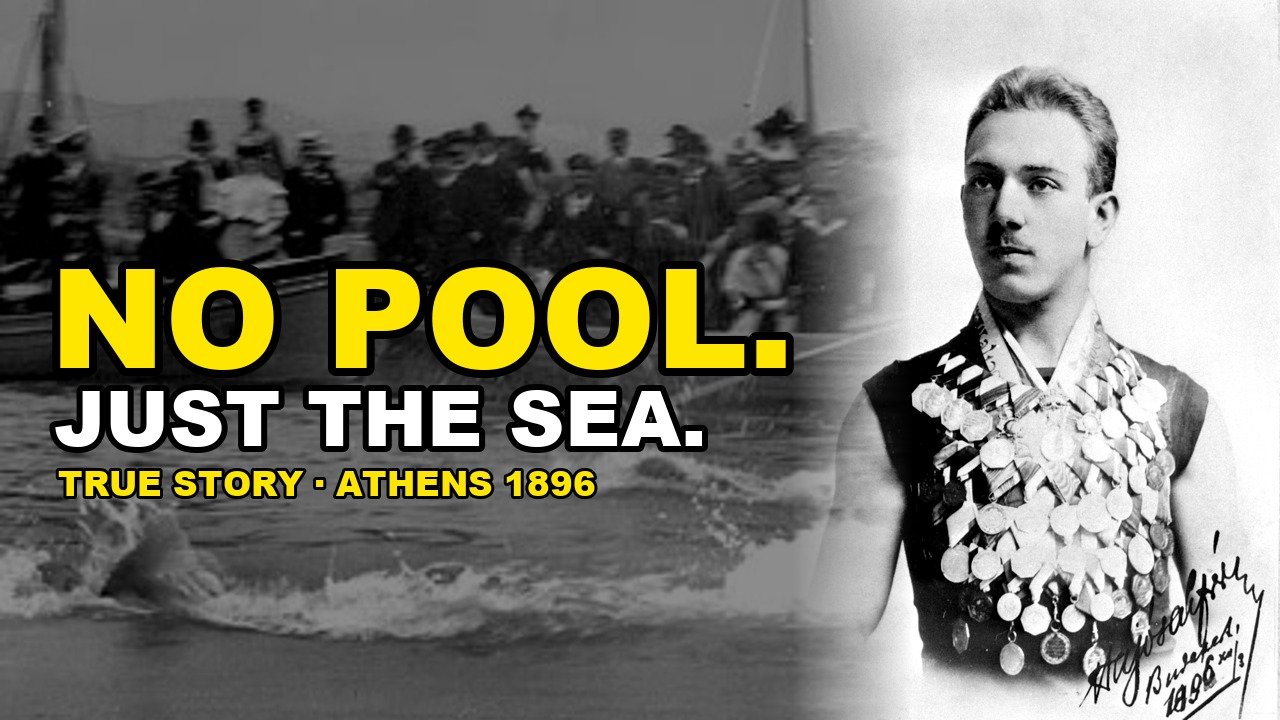
At the first modern Olympic Games, in 1896, there was no swimming pool. On the eleventh of April, boats took the swimmers out into the Bay of Zea, near the port of Piraeus, and left them in the cold, rough sea. The race was simple: swim back to the shore. Among them was an eighteen-year-old from Budapest. His father had drowned when he was a boy.
The Danube
He was born in Budapest in 1878, with the family name Guttmann. When Alfréd was thirteen, his father drowned in the River Danube. It is hard to imagine what that did to a young boy. But Alfréd made a decision: he would become a strong swimmer.
He swam whenever he could, and he became one of the fastest swimmers in Hungary, and later he took the name Hajós, which means sailor in Hungarian.
No pool in Athens
In 1896, Hungary sent a small team to the first modern Olympics in Athens. The organisers had rebuilt an ancient marble stadium for the runners, but there was no money and no time for a swimming pool. So the swimming races were held in the open sea.
The water in the bay was cold that April, and the wind made big waves. The Olympic Committee’s own history of the Games describes waves of up to about four metres. For swimmers used to rivers and baths, it was a frightening place to race.
The 100 metres
The first race was the 100 metres. The boats dropped the swimmers in the water, the signal was given, and they fought their way through the waves. Hajós reached the finish first, in 1 minute and 22.2 seconds. He was the first Olympic swimming champion in history.
There was a 500-metre race next, but it was held in between his two events, with too little time to recover. Hajós let it go. He wanted to save his strength for the longest race of all.
1,200 metres of waves
The 1,200 metres was a different kind of battle. Before the start, Hajós covered his body with a thick layer of grease, hoping it would keep out the cold. It helped very little. Out in the bay, the waves rolled over him again and again.
He later said that during the race his will to live completely overcame his desire to win. He was not swimming for a medal any more. He was swimming to reach the shore.
He reached it first. With a time of a little over eighteen minutes, he won the 1,200 metres too. Two Olympic titles, at eighteen years old, in a sea that had nearly beaten everyone.
In the water
The Greeks loved him. Newspapers called him the Hungarian Dolphin. When the Crown Prince of Greece asked him where he had learned to swim like that, he answered simply: in the water.
Back home, not everyone was impressed. The dean of his university showed little interest in his medals and told him to concentrate on his exams. Alfréd did. He studied architecture.
The architect
And he became a very good architect, one who specialised in sports buildings. In 1924, at the Paris Olympics, a stadium design by Hajós and his partner Dezső Lauber won a silver medal in the art competition. He is one of only two people to win Olympic medals in both sport and art.
In 1930 a new swimming stadium opened on Margaret Island in Budapest, built to his design. Today it is called the Alfréd Hajós National Swimming Pool. European championships have been held there, and every day children learn to swim in its calm water.
What we can learn
I find this story very moving. A boy lost his father to a river, and he could have been afraid of water all his life. Instead he swam through the sea, and then he built a safe place to swim for thousands of others. Many families carry a sorrow like this, something that happened long ago and quietly shaped everyone who came after. These stories are rarely told in full. Asking about them gently, and writing them down, can turn an old grief into a family’s strength.
A cold sea, waves crashing over his head, and a young man swimming for the shore. Today in Budapest a swimming pool carries his name, and children learn to swim in calm water.
Which old family story shaped the people who came after? Get free questions to ask them, read our step-by-step guide on how to write your life story, and start writing your own story at talesof.life.
Sources: Olympics.com – Hajos turns tragedy into glory in the water; Wikipedia – Alfréd Hajós; Swimming World Magazine – Hungary’s Alfréd Hajós overcomes heartbreak to become first Olympic champion; Wikipedia – Swimming at the 1896 Summer Olympics. Pictures: Alfréd Hajós and the 1896 swimming race in the Bay of Zea (public domain), via Wikimedia Commons.