
 Written by
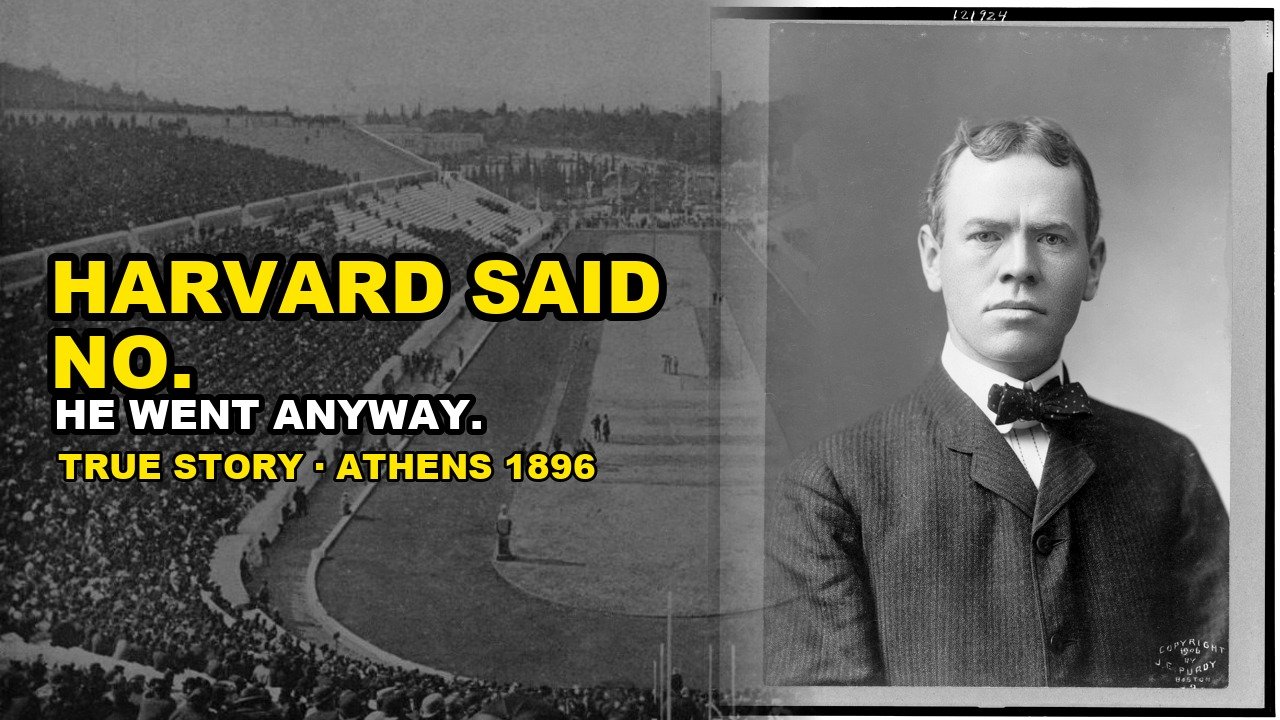
On the sixth of April 1896, on the very first day of the modern Olympic Games, a young American walked up to the runway in the Panathenaic Stadium in Athens. Tens of thousands of people were watching. Harvard University had told him he could not come. He had come anyway. And a few minutes later he would become the first Olympic champion in more than 1,500 years.
A boy from South Boston
James was born in Boston in 1868. His parents were poor Irish immigrants from the Aran Islands, off the west coast of Ireland. His father was a fisherman. James was one of twelve children, and he grew up in South Boston, a crowded neighbourhood of dockworkers and immigrant families, where sport was something you played in the street.
He was already a grown man of almost twenty-seven when, in 1895, he passed the entrance exam for Harvard and began to study the classics, the language and history of ancient Greece and Rome.
Harvard says no
That winter, he read that the Olympic Games were coming back, in Athens, the following spring. For a student of ancient Greece, it was a dream: to compete in the very city he was reading about. He asked Harvard for permission to leave for a few weeks. The university said no.
James did not give up. He asked to withdraw from the university instead, and on the nineteenth of March 1896 Harvard agreed. A famous, defiant reply is often quoted, but historians have never found proof that he said it. What we know is simpler: he chose the Games, and he left.
Robbed in Naples
He sailed from America on a German freighter, the Barbarossa, together with most of the small American team. When the ship stopped in Naples, in Italy, a thief stole his wallet and nearly took his ticket to Athens. James ran after the man, caught up with him and got the ticket back.
Then came a long train journey, and he arrived in Athens just in time. There was no training camp and no time to recover from the trip. The Games were about to begin.
Hop, hop, jump
The triple jump was one of the very first finals of the Games. In those days the rules were less strict than today. Connolly took off, hopped twice on his right foot, and then jumped into the sand. It looked strange, and it would not be allowed now, but it was allowed then.
His jump measured 13.71 metres. That was more than a metre further than anyone else. The crowd cheered, and the Irish American from South Boston walked back as the first Olympic champion of the modern era.
Think about that for a moment. The ancient Games had ended in the fourth century. For more than 1,500 years nobody, anywhere, had been called an Olympic champion. James Connolly was the first.
Silver for the winner
And here is a surprise. He did not get a gold medal. In 1896 there were no gold medals. Winners received a silver medal, a diploma and an olive branch. Second place got bronze. Gold medals for winners only came later.
Connolly was not finished. In the same Games he also finished second in the high jump and third in the long jump. Four years later, in Paris, he went back to defend his title and came second.
A life at sea
His life after Athens was as adventurous as his journey there. He reported on the Spanish-American War, sailed with fishermen and on ships, and turned all of it into stories. He wrote more than two hundred short stories and twenty-five novels, most of them about the sea and the people who work on it.
Harvard did not forget him either. In 1948 the university gave him an honorary athletic sweater. In 1949 it offered him an honorary doctorate. James Connolly, now an old man, politely declined. He died in 1957, at the age of 88.
What we can learn
I love this story because it is about going anyway. Almost every family has a moment like that: the grandmother who moved to the city when everyone told her to stay, the uncle who took a chance nobody believed in. These moments shape whole families for generations, and they are often told only once, at the kitchen table. They are worth asking about, and worth writing down.
A sandpit in Athens, a strange double hop, and a jump of 13.71 metres. The first Olympic champion in 1,500 years was a student who had been told he could not go.
Who in your family went anyway when everyone said no? Get free questions to ask them, read our step-by-step guide on how to write your life story, and start writing your own story at talesof.life.
Sources: Wikipedia – James Brendan Connolly; Olympics.com – Connolly takes a leap into the history books; Wikipedia – Athletics at the 1896 Summer Olympics, men’s triple jump; Wikipedia – 1896 Summer Olympics. Pictures: James Brendan Connolly (Library of Congress, public domain) and the Panathenaic Stadium in 1896 (public domain), via Wikimedia Commons.