
 Written by
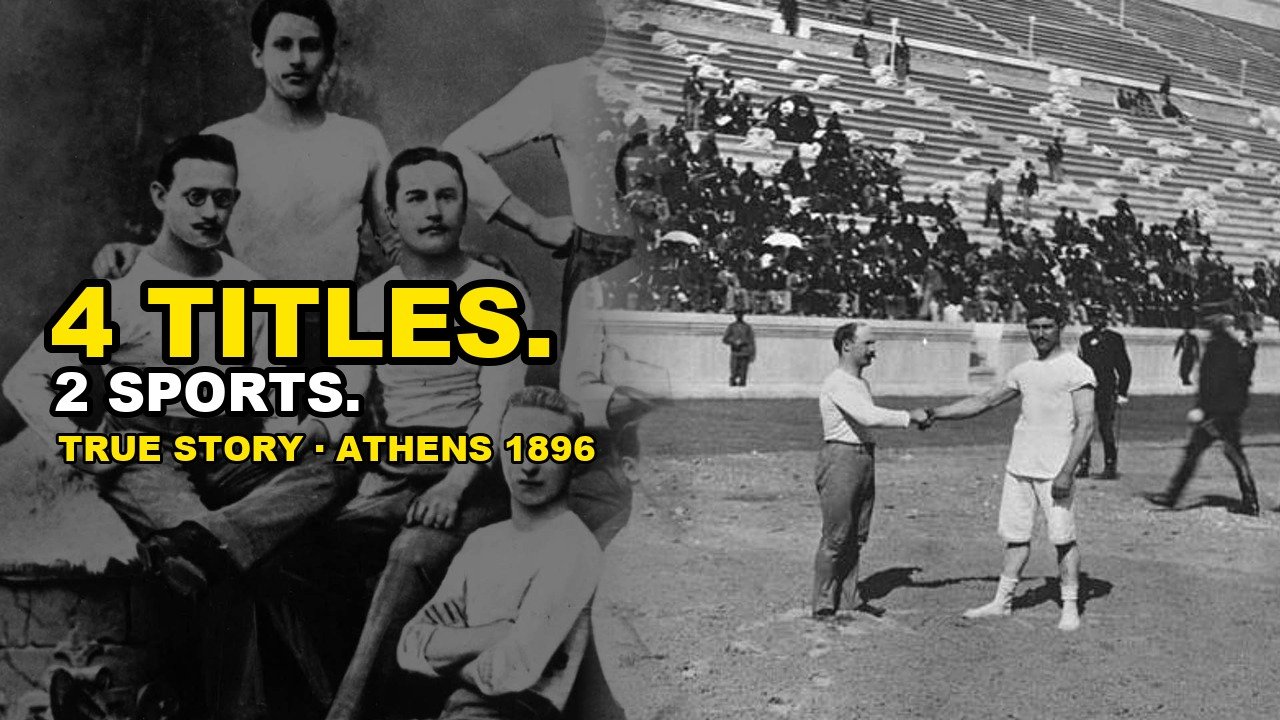
One evening in April 1896, in the stadium in Athens, two men had been wrestling for forty minutes. The sun was going down. Soon it was too dark to see who was winning, and the judges stopped the match. They would have to come back the next morning. One of the two men was much smaller than the other. And he was already an Olympic champion three times over.
A gymnast from Berlin
Carl was born in 1869 in Münster, in western Germany. He became a gymnast, and he trained with the Berliner Turnerschaft, one of the big gymnastics clubs of Berlin. German gymnastics in those days was about the whole body: strength, balance, jumping and climbing.
In 1896 Germany sent a team of eleven gymnasts to Athens. Carl Schuhmann was one of them. He was strong, quick and remarkably versatile, and he was ready to try almost anything.
Three gymnastics titles
The gymnastics events came first. With his team, Schuhmann won the parallel bars and the horizontal bar. Then he won the vault on his own. Three Olympic titles in gymnastics alone. He also tried the individual rings, pommel horse, parallel bars and horizontal bar, and finished fifth on the rings.
Most athletes would have been happy with that. Carl Schuhmann had other plans. He also entered the wrestling.
No weight classes
In 1896 Olympic wrestling had no weight classes. Everyone wrestled everyone, whatever their size. It was the only wrestling event of those Games, and the only time in Olympic history that wrestling was open to all sizes. Weight classes arrived in 1904. There was no time limit either. Only five men entered: two Greeks, a Hungarian, a Briton and one German gymnast. That meant a gymnast like Schuhmann, much smaller and lighter than most of his opponents, could be drawn against a giant.
And in the first round, he was. His opponent was Launceston Elliot of Great Britain, a huge, powerful man who had just won the weightlifting. On paper it was not a fair fight.
But wrestling is not only about strength. It is about balance, timing and technique, and Schuhmann had trained those all his life. He beat Elliot easily. After a bye in the semi-final, he was in the final. In the other semi-final, Georgios Tsitas had beaten his countryman Stephanos Christopoulos, who retired with a shoulder injury.
Forty minutes
His opponent in the final was Georgios Tsitas of Greece, and the home crowd was behind him. The two men gripped each other and wrestled, and wrestled, and neither would give way.
After forty minutes the light was fading. It was getting too dark to wrestle safely or to judge fairly, so the officials stopped the bout and told both men to come back the next day.
Imagine that night. Tired, sore, knowing that one more fight was waiting in the morning. When they met again, it did not take long. Schuhmann won the match by a fall. It was his fourth Olympic title.
Everything at once
And he still was not done. In the same Games he lifted weights and tied for fourth place in the two-handed lift. He competed in the long jump and the shot put, and he finished fifth in the triple jump. Few athletes in Olympic history have tried so many different events at a single Games.
Schuhmann stayed true to gymnastics all his life. In 1936, when the Olympic Games came to Berlin, he took part in a gymnastics display in the Olympic Stadium, at the age of sixty-seven.
Rings on a gravestone
He died in Berlin in 1946. His gravestone carries the five Olympic rings, the words Germany’s first Olympic champion, and two more words: Athens 1896. Today a memorial plaque in Berlin also remembers him.
What we can learn
I like his story because nobody would have picked him to win the wrestling. Every family has someone like Carl Schuhmann, someone who was told they were too small, too young or too old, and did it anyway. Usually there is no medal and no photograph, only a story told at birthdays. Those stories are a family’s real treasure, and they deserve to be written down.
A wrestling ring in Athens, two tired men, and the sun going down. And in Berlin, a gravestone with five rings and two simple words: Athens 1896.
Who in your family was told they were too small for something, and did it anyway? Get free questions to ask them, read our step-by-step guide on how to write your life story, and start writing your own story at talesof.life.
Sources: Wikipedia – Carl Schuhmann; Wikipedia – Wrestling at the 1896 Summer Olympics, men’s Greco-Roman; Olympics.com – Carl Schuhmann; Wikipedia – Gymnastics at the 1896 Summer Olympics. Pictures: Carl Schuhmann wrestling and the German gymnastics team at Athens 1896, photographed by Albert Meyer (public domain), via Wikimedia Commons.