
 Written by
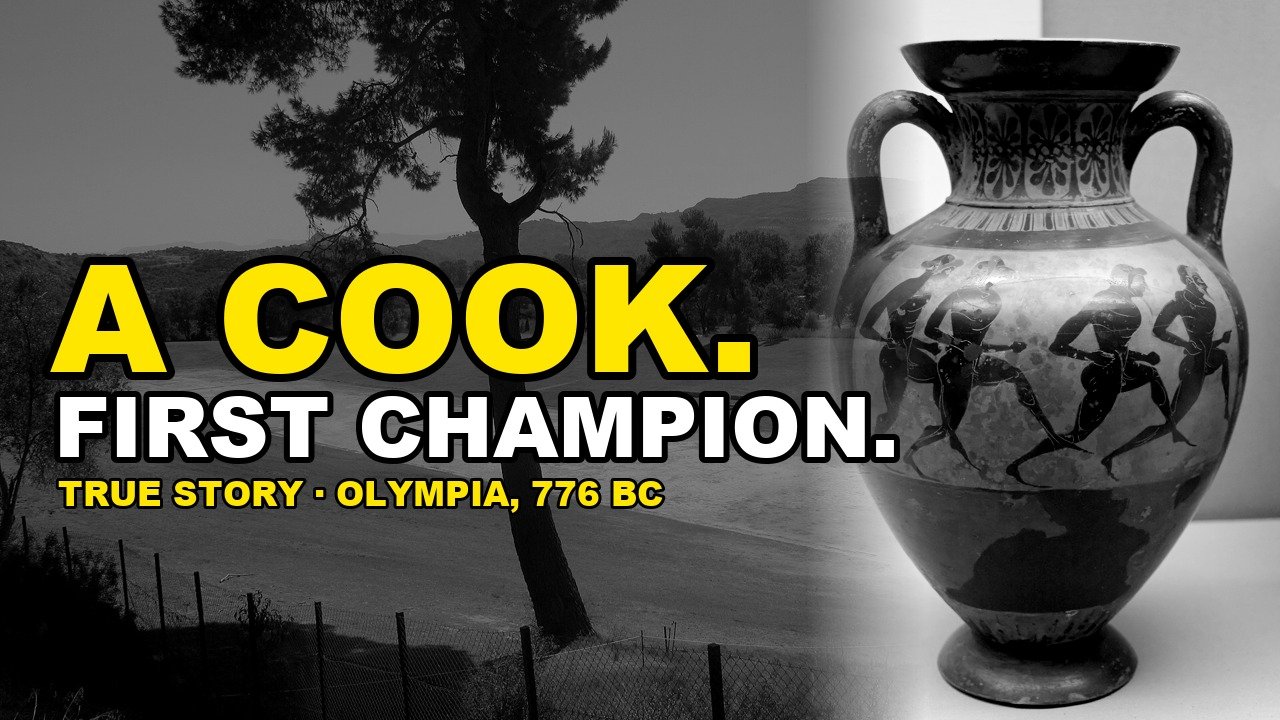
The first Olympic champion whose name we know was a cook. His name was Koroibos, he came from the town of Elis in southern Greece, and in the summer of 776 BC, according to tradition, he won the only race of the Games at Olympia. It was one length of a field. About 192 metres. And his prize was a wreath of wild olive leaves.
Olympia, a holy place
Olympia was not a city. It was a holy place, a sanctuary of Zeus, the king of the Greek gods. It lay in a green valley in the west of the Peloponnese, where two rivers meet, below a wooded hill called the Hill of Kronos.
The people of Elis, a farming region nearby, looked after the sanctuary and ran the festival. Every four years, people came from all over the Greek world to honour Zeus with sacrifices, with prayers, and with a contest of speed.
Later writers say that during the festival a sacred truce was announced, so that athletes and visitors could travel to Olympia safely. Historians still argue about exactly how it worked, but the idea is a beautiful one: for the time of the Games, the roads were meant to be open to everyone.
One race, about 192 metres
The race was called the stadion. The word simply means one stade, a length of about six hundred Greek feet, or roughly 192 metres. The runners lined up at one end of a flat strip of earth and ran as fast as they could to the other end. That was all. No laps, no relay, no second chance.
According to the old list of winners, for the first thirteen Olympiads this single sprint was the whole competition. Only later were longer races added, then wrestling, boxing, the pentathlon and the chariot races. But in 776 BC there was just one race. And a cook from Elis won it.
How we know his name
How do we know any of this? The honest answer is: from a list. Around 400 BC, more than three hundred years after Koroibos ran, a scholar from Elis named Hippias put together a list of Olympic victors. Koroibos was the first name on it. Because of that list, Greek historians started counting time in Olympiads, four-year periods beginning with his victory.
Modern historians are careful here. Some ancient writers believed that Games had been held at Olympia even earlier, and that Koroibos was only the first winner anyone had written down. Some scholars think the early part of the list was partly reconstructed. Ancient sources also call him a cook, and some say a baker. What we can say is this: Koroibos is the first Olympic champion whose name has survived.
And his name was treasured. The people of Elis honoured him for centuries. Around the second century AD, about nine hundred years after his race, the Greek traveller Pausanias wrote that the grave of Koroibos could still be seen, and that its inscription said he was the first man to win at Olympia.
A thousand years of Games
The Games he won grew into something enormous. Over the centuries the stadium at Olympia was rebuilt and enlarged, until around forty thousand spectators could sit on its grassy slopes. Athletes walked in through a stone tunnel, under the eyes of the judges. Winners still received only a wreath of olive, but their home towns welcomed them like heroes.
The ancient Games lasted more than a thousand years. They are traditionally said to have ended in the late fourth century AD, when the Roman Empire turned away from the old gods. Earthquakes, floods and time slowly buried Olympia under the earth, and for centuries the place where Koroibos ran was a quiet field.
Then, in the nineteenth century, archaeologists began to dig Olympia out again. Ruined temples and the old stadium came back to light, and people in Europe began to dream of reviving the Games.
1896: the Games come back
A young French baron named Pierre de Coubertin turned the dream into a plan. In 1894 he gathered supporters in Paris and founded the International Olympic Committee. They chose Athens, the capital of Greece, for the first modern Games. The ancient Panathenaic Stadium was rebuilt in shining white marble, and on the sixth of April 1896, around 240 athletes from about fourteen countries walked into it.
Over the next six episodes, you will meet some of them. People who quit their studies, swam in a stormy sea, came as tourists, wrestled until it was too dark to see, ran when they were not allowed to, and carried water for a living. Ordinary people, every one of them.
What we can learn
Almost everything about Koroibos is lost. We do not know his face, his family, or what he liked to cook. We do not know what he felt when he crossed the line. But his name survived, because someone cared enough to write it down. And that is the lesson I keep coming back to. Most people in every family are never written down at all. Within two or three generations, even their names are gone. A few pages, written while we still can, are enough to keep a life from disappearing.
One race, one length of a field, one wreath of wild olive. And one name on a list, still remembered almost 2,800 years later. Everything the Olympics became began with a cook who ran as fast as he could.
Who in your family deserves to be remembered by name? Get free questions to ask them, read our step-by-step guide on how to write your life story, and start writing your own story at talesof.life.
Sources: Wikipedia – Coroebus of Elis; Wikipedia – Ancient Olympic Games; Olympics.com – Ancient Olympic Games; Wikipedia – 1896 Summer Olympics. Pictures: the ancient stadium at Olympia and a Panathenaic amphora showing a foot race (British Museum, public domain), via Wikimedia Commons.